


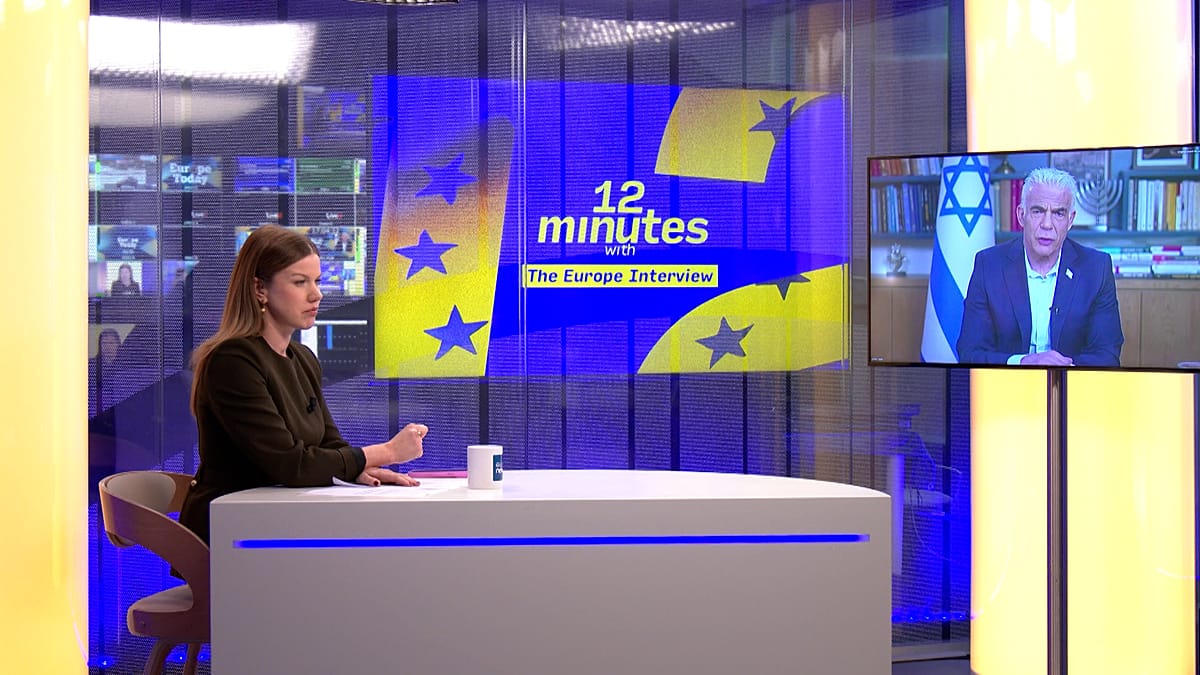
The leader of the Israeli opposition, Yair Lapid, told Euronews that no one can “push” US President Donald Trump into anything, as he denied speculations that the decision to attack Iran came from Israel and not Washington.
ADVERTISEMENT

ADVERTISEMENT
“Does Donald Trump strike you as someone who can be pushed around? I don’t think so,” Lapid said on Euronews’ interview programme 12 Minutes With.
“He’s the president of the biggest military army in the history of humanity. He’s a determined man. Israel is filled with gratitude and admiration for his courage, for his moral clarity on the issue, for the fact that he decided to go into this war, understanding this is protecting peace on Earth.”
He went on to say that, with the exception of Melania (US First Lady), he does not think “anybody can push Donald Trump to do something he doesn’t want to do.”
US President Trump declared on Friday that the US was “totally destroying” Iran’s ruling regime – “militarily, economically and otherwise” – and that it was his “great honour” to be killing them in a post on his Truth Social platform.
The leader of the Israeli opposition touched on the endgame for the Iran war, saying regime change is one of the main goals. While he does not believe “in the ability to change a regime with airstrikes,” he is convinced it can create “better conditions for the Iranian people to take their fate and their destiny into their own hands.”
“I think last January, when they took to the streets, and they were killed by the thousands, by the Basij (paramilitary force that falls under the IRGC) and the revolutionary guards, they felt alone. And I don’t think they feel alone right now.”
Lapid told Euronews he believes that the “conditions and the ability and the probability of them changing the regime have grown significantly.”
“Now it’s up to the Iranian people. I don’t know if there will be an Iranian Nelson Mandela, an Iranian Gandhi, or an Iranian Lech Wałęsa. But I hope for their sake, for the people of Iran, there will be a regime change.”
Iran’s new Supreme Leader threatened US and Israel
In his first public remarks as Iran’s new supreme leader, Ayatollah Mojtaba Khamenei said Iran will “avenge” those who were killed in US-Israeli airstrikes.
Lapid said he does not feel threatened and that this latest statement does not differ from Iran’s stance on Israel pre-dating the war.
“It’s not like they didn’t try to kill Israelis and Americans and people from the EU and Saudi Arabia and everywhere else before that,” he explained. “This is what they do, that’s the regime, that took hostage an entire country, a glorious culture, the Iranians are an ancient culture, that was taken by force by the people who are saying these kinds of things.”
The opposition leader also argued that there is a big difference between the Israeli and Iranians attacks and the casualties these cause, namely that Tehran is intentionally attacking civilians.
Earlier, in an exclusive interview with Euronews, Iran’s ambassador to the UN, Ali Bahreini, accused the US and Israel of deliberately targeting civilian infrastructure in Iran.
When asked about the more than 1,200 people that Tehran has claimed have died since the beginning of the US-Israel war, Lapid said, “These are casualties of war. Nobody killed them intentionally.”
He added that the US-Israeli operation is “targeting strictly military targets,” while Iran is “targeting Israeli and other countries’ civilian targets to kill as many civilians as possible.”
When asked by Euronews about the alleged US strike on the Shajareh Tayyebeh girls’ elementary school in Minab on 28 February, Lapid described it as “a terrible, terrible, horrible tragedy”.
US media have reported that US military investigators believe American forces were likely unintentionally responsible for the attack, which Iranian officials say killed 175 people, including more than 100 children. However, a final conclusion has not yet been reached.
“My heart goes out to the parents,” Lapid said, admitting this is something that “should not happen, but does happen in war.”
He emphasised that “nobody wanted this to happen” or intended for it to happen.
“Nobody’s claiming that war is not a horrible thing. Sometimes, even a just war is a horrible thing because there are casualties, and there are civilian casualties. And again, I send my condolences to the parents of those children.”
Implications for the wider region
Iran-backed group Hezbollah has also entered the ongoing war, dragging Lebanon into the major military escalation with Israel.
Lebanese officials told Euronews that Beirut has asked for direct talks with Israel, through a US intermediary, to try to put an end to an Israeli offensive that has already cost close to 700 lives and displaced around 820,000 people, according to the latest figures.
When asked whether Israel would consider such dialogue, Lapid responded that he would, if it were up to him.
“I would use this like a scissor effect,” he said, explaining that to fight Hezbollah, he would go into southern Lebanon, “making sure Hezbollah is pushed over the Litani River.”
He added that, while doing that, it is important to “negotiate with the Lebanese government, because it’s [Hezbollah] their problem as well.”
“Right now, it’s up to the Lebanese people to determine whether it’s a country with a terror organisation or a terror organisation with a country. If Lebanon wants to be a real country, then they need to do much more in controlling Hezbollah.”
Lebanese President Joseph Aoun has already called for a ceasefire to stop hostilities by land and air, and said his country was being forced into a fatal choice of direct military confrontation with Israel or risk turning Lebanon into another Gaza.
Last week, Lebanese Prime Minister Nawal Salam declared Hezbollah’s military operations “illegal” in the wake of its launching rockets at Israel. The Lebanese government has said it would, however, tolerate that Hezbollah solely operates as a political party.
Israeli Prime Minister Benjamin Netanyahu has, however, shown increasing signs that he will not stop at demilitarising Hezbollah but would want to see it completely disappear from Lebanon’s political scene as well. Besides its paramilitary activities, Hezbollah is a long-time political actor and provider of social services.


