




Published on
AI-driven robots currently in operation in a huge e-commerce warehouse near Berlin have been designed to handle over 600 units per hour. The robots are able to autonomously identify the nature, size, shape and weight of each item and its packaging, and to optimise its handling.
ADVERTISEMENT

ADVERTISEMENT
“The robots work 24/7. So if you’re comparing robots with humans, they don’t need to take breaks. They can keep going, and they’re basically consistent,” explains Nitin Annam, Head of Operations at CEVA Logistics. “It’s not necessarily about replacing people with automation. It’s more about how we produce more volume at a cheaper cost and be more efficient”
Without these AI-driven solutions, e-commerce business models are not viable any more, claims Klaus Lichtenfeld, Head of Logistics for the European Union at the online fashion retailer that uses this distribution centre as its main hub in continental Europe.
“Our e-commerce business is very volatile. This makes it very difficult to plan the staff properly,” says Lichtenfeld. “The advantage of robots is that they’re always there and can easily help us cope with volume spikes.”
The robotic solution has been engineered and tested by a start-up with 140 staff in Poland’s capital Warsaw. Engineers here have developed cloud-based AI solutions that help robots learn from every pick.
“When the robot is working, we collect all the metrics we can, all the readings from all the sensors, all the images of every single bin that the robot would see. And we use this data to train the machine learning model and adjust it further,” explains Ewa Maciaś, Director of Software Engineering & User Experience at Nomagic. “The robots can adapt to new items that it sees for the first time, and to different shapes, sizes and kinds of items.”
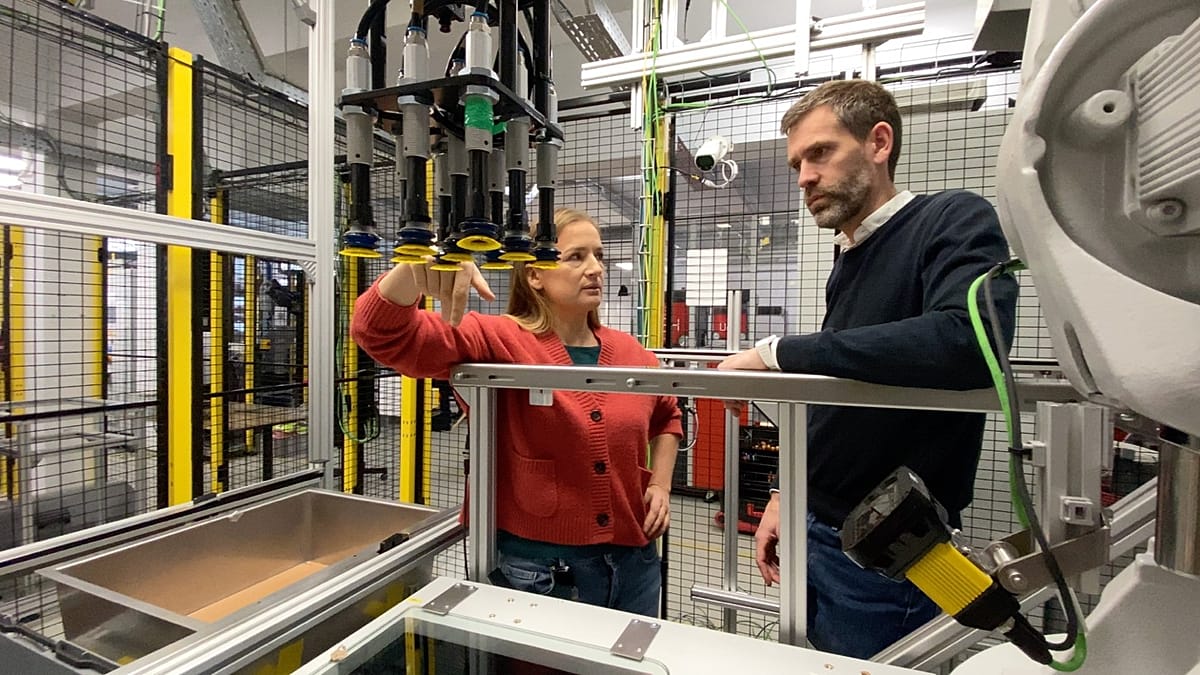
One of the technological challenges is to develop the ideal pickers, the ‘robotic hands’ dealing with a wide variety of items and packages, from plastic wrapping to shoeboxes. “You have the lid of the shoe box, the bottom of the shoe box and the item inside,” explains mechatronics design engineer Mateusz Karolak. “Picking only the lid, for example, doesn’t count as success. You need to pick the whole item and make sure that it will stay together without separating.”
The start-up has reported to have tripled its business volume and number of clients — including big retailers — in the last few years. In 2025, it announced that it had secured investment of around €50M to drive AI innovation in robotics. Both developers and end users claim to also be keeping an eye on the social impact of this full-steam AI-driven development in e-commerce logistics.
“The robot still requires some maintenance. We’re working together with our clients on educating their staff. And we’ve seen cases where the employees take pride in working in a more advanced, higher tech environment rather than performing a lot of very manual tasks,” says Kacper Nowicki, Nomagic’s CEO.
“A humanless warehouse is impossible,” adds Lichtenfeld. “That will never work. So there will always be human employees, people working in a warehouse. We’re not necessarily replacing man with machine,” concludes Annam. “It’s more about creating harmony and moving forward.”