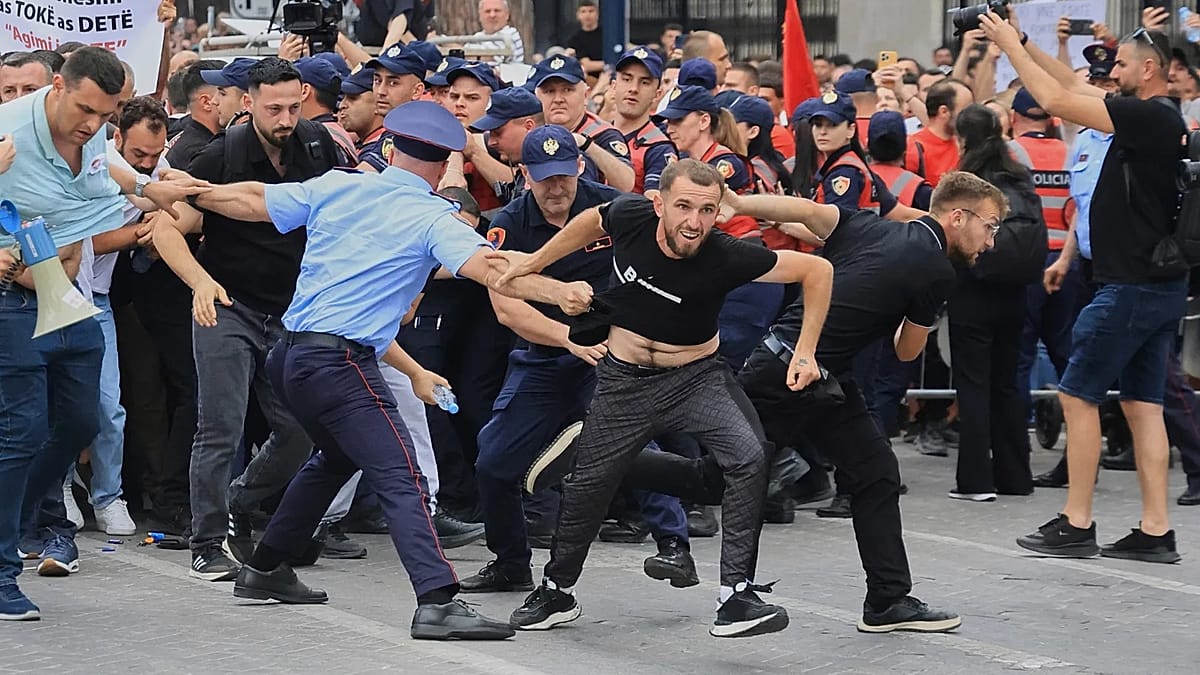

The government has already responded to Wednesday’s general stoppage, playing down its overall impact. Even so, the late afternoon was marked by scuffles outside the Assembly of the Republic, where one of several demonstrations against the labour law was taking place on this day of general strike.
ADVERTISEMENT

ADVERTISEMENT
According to the newspaper Observador, five people were detained by the Public Security Police (PSP) following clashes between the two sides. Several rubbish bins were also set on fire, and the authorities ordered protesters to leave the area, an order that was not complied with.
Prime Minister Luís Montenegro said, following the Council of Ministers meeting, that the stoppage “served only to harm a lot of people”, while stressing that he did not intend “to call into question the exercise” of that right.
He illustrated this point, in comments quoted by CNN Portugal (source in Portuguese): “Many of the children whose schools did not open, many of the young people who were unable to sit exams because the conditions to do so were not in place, many Portuguese who had consultations or planned surgeries and could not see them carried out, and some who could not travel to their workplace because it was impossible to get there, were genuinely harmed by this strike.”
Later, Labour Minister Maria Rosário da Palma Ramalho said participation in the strike in the private sector “was marginal”, as the “overwhelming majority of workers decided to go to work”. As for the public sector, she said the “figures” pointed to “23% staff absences”.
Earlier, at an 11.30 a.m. news conference, the labour minister had insisted that the country was “operating normally” and that in “some areas” participation was “actually non-existent”.
In a detailed breakdown by sector, she said that “all factories” were “at work”. Shops also had their “doors open”, there were no “branches closed” in banking and tourism saw “no disruption, including at travel agencies”. This despite constraints at airports, with flights cancelled.
The minister also said that private hospitals were “operating as normal” and, regarding the public sector, acknowledged “higher participation”.
However, despite greater disruption in the public sector, Maria Rosário Ramalho maintained that “services” were “being ensured” and reiterated that “the government listens to everyone and fully respects the right to strike”.
This reading by the government clashes with statements by the secretary-general of CTGP-IN (Confederação Geral dos Trabalhadores Portugueses – Intersindical Nacional), Tiago Oliveira, who said that “the figures point to a major strike”.
Early in the afternoon, Tiago Oliveira spoke to reporters to present data from private industrial companies where participation in the strike reached 100%, such as DS Smith-Leiria, Saica, Sovena and Cedial.
The union leader also pointed to strong participation at companies in the construction, ceramics, cement and glass sectors.
Contrary to what the minister had said, the trade union confederation reported significant impacts at private hospitals, namely the Lusíadas hospitals in Amadora and Lisbon, CUF Hospital in Sintra and Hospital da Luz in Lisbon.
In the transport sector, Tiago Oliveira cited 100% participation at Lisbon Metro, TransdevViseu, Empresa Transportes Urbanos da Guarda and Transportes Urbanos da Covilhã, as well as “Oficinas Carris with 98% participation, Soflusa/Transtejo with 85% participation and CP operating only minimum services”.
“The aim is to denounce the labour package, to have the labour package withdrawn,” said Tiago Oliveira outside Nuno Gonçalves primary school in Lisbon on Wednesday morning; the school was closed because of the general strike.
“For ten months, workers have been showing that they do not want the labour package and the prime minister (Luís Montenegro) has shown arrogance and a lack of respect towards workers,” he added.
Hospitals affected since yesterday
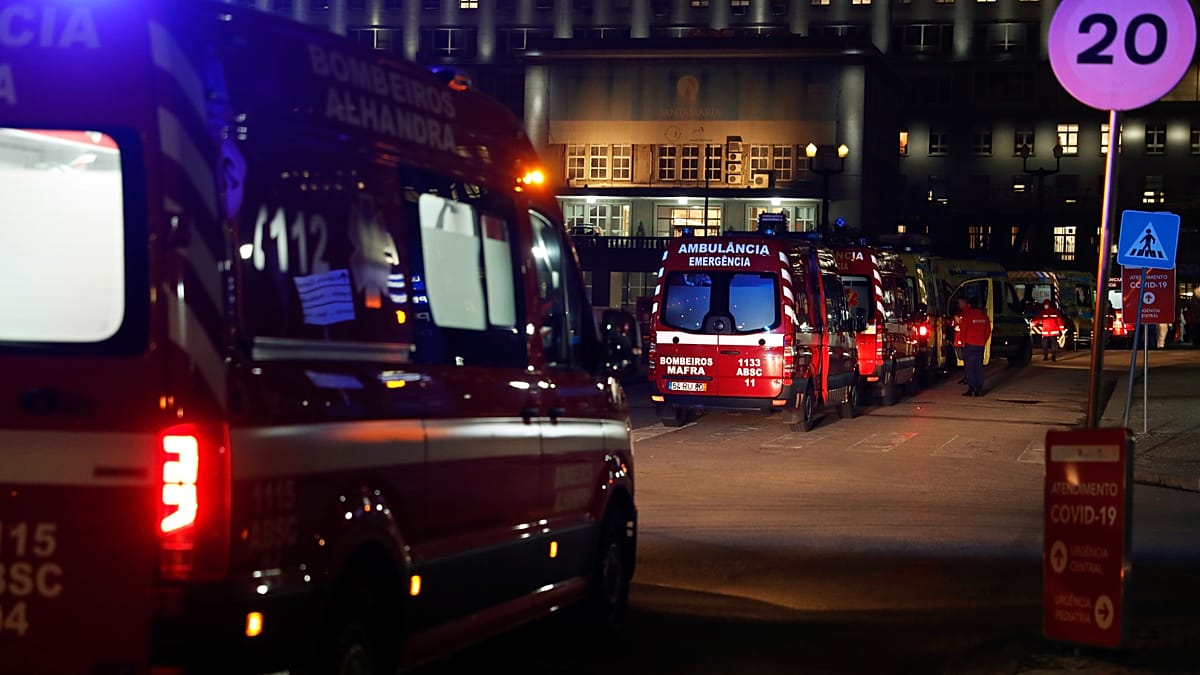
The general strike brought an almost total shutdown of the night shift at National Health Service (SNS) hospitals.
According to the National Federation of Unions of Workers in Public and Social Functions (FNSTFPS), participation by SNS workers in last night’s strike stood between 95% and 100%, revealing strong opposition to the labour package.
The impact of the stoppage was felt at several healthcare units across the country. São Francisco Xavier Hospital, part of the Lisbon West Local Health Unit (ULS Lisboa Ocidental), and São José Hospital, part of the Lisbon East Local Health Unit (ULS Lisboa Oriental), recorded 100% participation in the strike. At Santa Maria Hospital, also in ULS Lisboa Ocidental, participation reached 90%, while at Vila Franca de Xira Hospital, part of ULS Estuário do Tejo, it was 71%.
In Porto, there was full participation in the strike at the ULS Viseu Dão Lafões Hospital and at São João Hospital. The Portuguese Oncology Institute in Porto reported participation of 90%.
The Bissaya Barreto Maternity Hospital and the University Hospitals campus, both part of the Coimbra Local Health Unit (ULS de Coimbra), experienced a total stoppage by their workers. At Santarém Hospital, part of ULS da Lezíria, participation in the strike was 74%.
According to SIC Notícias, outpatient consultations at Portalegre Hospital are not taking place, although minimum services are being ensured.
This is the first time that workers at SNS 24 (source in Portuguese) have joined a general strike, which means it may be more difficult today to speak to a health professional via this telephone helpline. Waiting times may even reach three hours. The stoppage comes at a time when the SNS 24 line is already under intense operational pressure.
Schools closed on the day of the Year 6 Portuguese exam
Many schools around the country are also closed, affecting the Portuguese exam for Year 6 pupils, scheduled for Wednesday.
Speaking to SIC Notícias, the secretary-general of FENPROF, José Feliciano da Costa, said there was “significant participation” in the strike in Sintra, Olivais, Fundão, Coimbra, Moita, Castelo Branco and Mafra. In his view, the education minister’s decision not to postpone the exam shows that “the exams are not important” and “can be held on any other day”.
Almost 190 flights cancelled, metro halted and river crossings cut
As for international flights, almost 190 services had been cancelled at Lisbon, Porto and Faro airports by mid-afternoon.
On the ANA – Aeroportos de Portugal (source in Portuguese) website, at least 43 arrivals are shown as cancelled at Lisbon airport, along with 46 departures. At Francisco Sá Carneiro airport in Porto, 29 arriving flights and 27 departures have been cancelled. In Faro, 21 arrivals and 23 departures have been cancelled.
The Lisbon Metro (source in Portuguese) is also at a standstill, as there are no minimum services in operation. On the Porto Metro (source in Portuguese), which has four lines out of service – Green, Red, Violenta and Orange – only the Blue and Yellow lines are running.
Tagus River ferry operator Transtejo (source in Portuguese), which links the two banks of the river, has cancelled several services. CP – Comboios de Portugal (source in Portuguese), the national rail operator, meanwhile expects disruption to train services.
More than two dozen companies across the country have also suspended activity.
The Labour Code stipulates that in the event of a strike, minimum services must be ensured in companies or facilities providing essential services to meet urgent social needs. These include postal and telecommunications services, medical, hospital and pharmaceutical care, public hygiene and health – including funerals – as well as energy and mining services, in particular the supply of fuel.
This stoppage is part of a protest against the proposed changes to labour legislation, also known as “Trabalho XXI”, put forward by the PSD/CDS-PP government and comprising more than 100 amendments to the Labour Code.
The package of measures was discussed in the Social Concertation forum, but the government led by Luís Montenegro failed to reach agreement with the social partners, prompting CGTP-IN to move ahead with the formal notice for the previously announced strike.