
The European Union will retaliate against China if the country fails to make tangible changes to its unfair trade practices by October, Ursula von der Leyen has said amid rising tensions between Brussels and Beijing.
ADVERTISEMENT

ADVERTISEMENT
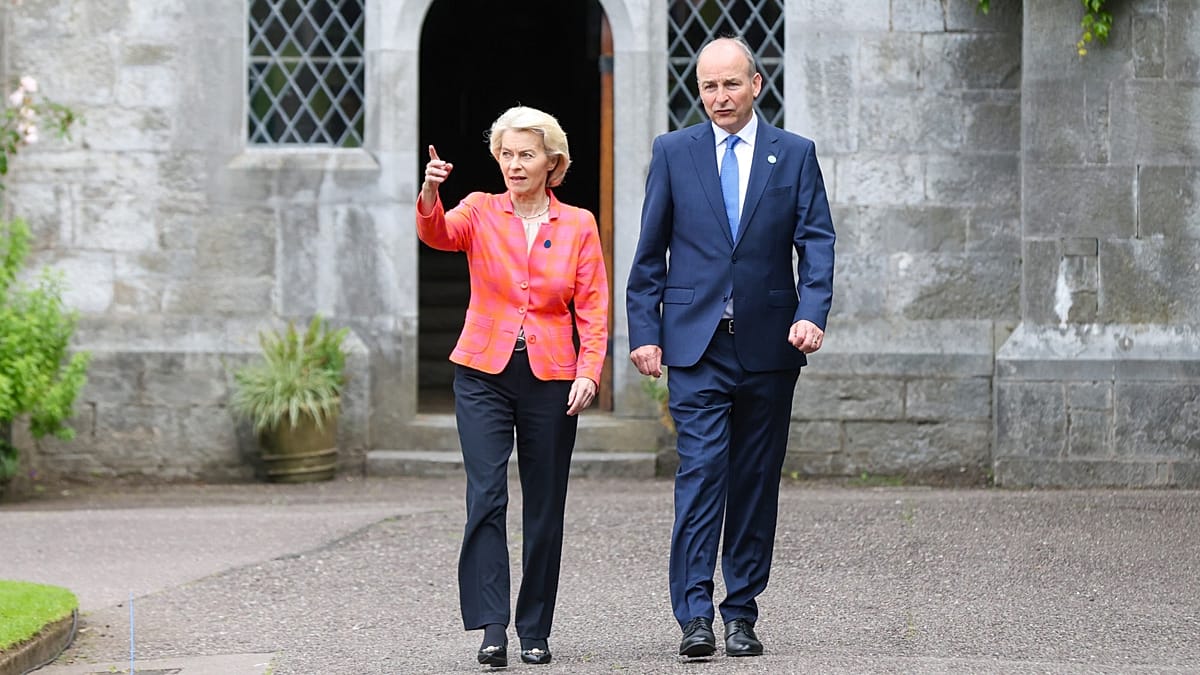
“Dialogue is essential, but the dialogue has to deliver,” the president of the European Commission said on Friday during an official visit to Cork, Ireland.
“Depending on how the response of the Chinese is, in the fall will then be our potential activity. We are basically prepared for everything, and we have all the instruments on the table, and we are thinking about other possibilities if necessary.”
Von der Leyen listed several friction points, such as China’s glut of low-cost exports, stringent restrictions on European companies, and excessive use of state subsidies, which she said “we don’t want to see any more on our market”.
However, she did not specify which practices would be addressed, or how, if the October rubicon was passed.
Her subtly veiled threat comes on the heels of a consequential EU summit that saw the 27 member state leaders give her a mandate to adopt a tougher stance on China, saying the Commission should seek to foster dialogue while at the same time exploring the suitability of existing and new trade instruments.
The Commission is already armed with the Anti-Coercion Instrument, which would allow Brussels to hit back at Beijing with varying degrees of intensity. But this tool has proven too cumbersome and divisive among member states, and has never been used.
This is why von der Leyen’s services are now working on at least two additional instruments to complement the arsenal: one to diversify supply chains and reduce vulnerable dependencies, and another to ensure solidarity in the event of Chinese reprisals, which are certain to happen if the EU becomes more assertive.
It remains to be seen if von der Leyen will manage to keep the 27 leaders, whose views on China still diverge, on the same page when push comes to shove.
Irish Prime Minister Micheál Martin, whose country has just assumed the EU Council’s presidency, offered remarks of his own while appearing with von der Leyen on Thursday.
“Trade has to be conducted on a fair basis, and we all have to play by the same rules, and that is not always the case,” he said.
“I would hope the dialogue can reach a landing zone between Europe and China, because at the end of the day, there is significant interdependence as well, all across the globe, and that includes China. So everybody needs everybody to some degree.”
As leaders weigh the pros and cons of standing up to China after years of inaction, Brussels is keen to maintain the momentum injected by the mandate.
Maroš Šefčovič, the European Commissioner for Trade, met with his Chinese counterpart Wang Wentao earlier this week to discuss ways to rebalance bilateral trade.
Last year, the bloc recorded an eye-popping €360 billion trade deficit with China. It was the first time that every single one of the 27 member states posted a negative number.
After the meeting, Šefčovič imposed a deadline on China to deliver “the first tangible results” by October. He admitted that “not everything will be fixed” by then, but expressed confidence that there would be “sufficient time” to make a difference.
“The trend is not sustainable, and the status quo is not an option,” Šefčovic said after the meeting, which he described as “intensive, focused and constructive”.
Bernd Lange, the chair of the European Parliament’s trade committee, has said the October deadline is “not realistic at all” if Brussels wants to secure binding concessions.