


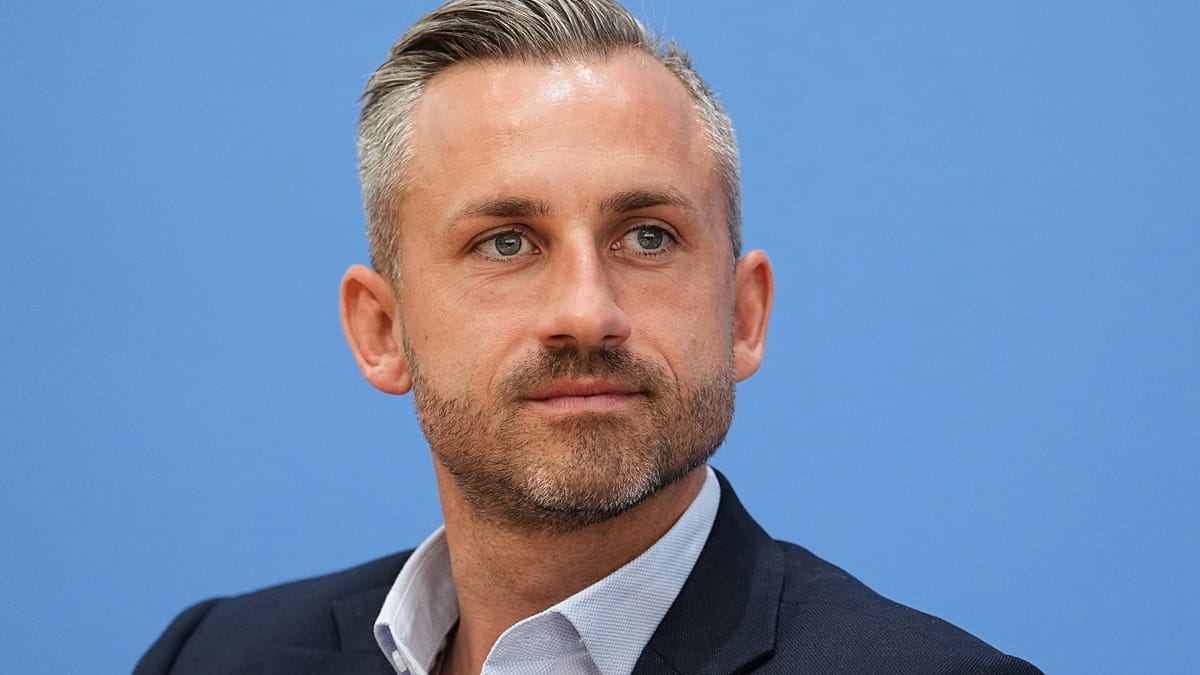
The AfD’s lead candidate in the Saxony-Anhalt state, Ulrich Siegmund, has sparked fierce criticism with remarks about the possible use of military equipment in a future “remigration and deportation offensive”.
ADVERTISEMENT

ADVERTISEMENT
The background is the planned establishment of a production site of the Israeli defence company Elbit Systems in Sangerhausen. At a press conference, Siegmund drew a link between the production of armaments, domestic security and the migration policy his party is pursuing.
Siegmund initially stated that the AfD did not fundamentally oppose the production of armaments. Arms production could, among other things, be important for domestic security, the stability of the country and national defence. He then referred to his party’s migration policy objectives.
“The production of military equipment was not being demonised across the board,” he said, because suitable means would be needed later for “remigration and deportation offensives.”
Following the criticism that ensued, Siegmund clarified his remarks.
Arms production was a broad field and covered not only weapons but also vehicles, protective technology and other equipment on which the Bundeswehr, the police and security agencies depended.
In his view, these areas needed to be strengthened, not least in order to enforce the law, carry out deportations consistently and make a “genuine remigration offensive” possible.
If a new site served national defence, domestic security and the enforcement of law and order, this was, from the AfD’s point of view, a duty of the state.
‘No arms for foreign wars’
At the same time, the AfD politician stressed that his party rejected supplying military equipment for “foreign wars”.
There was, he noted, a major difference between Germany producing such equipment itself and supplying it to conflicts abroad and thereby possibly taking part in them.
The AfD therefore wanted to examine closely what would be produced in Sangerhausen and under what conditions.
The possible arrival of Elbit Systems in Sangerhausen has already been causing controversy for some time. There have been protests against the project from the local population, which are also supported by the The Sahra Wagenknecht Alliance (BSW).
The company is an Israeli defence group based in Haifa that develops and manufactures, among other things, drones, howitzers, rocket launchers as well as communication and self-protection systems for military use.
Its best-known products include the Hermes and Skylark drone models.
In Germany, the company’s headquarters are in Ulm. According to its own information, Elbit is already working for the Bundeswehr and supplies, among other things, self-protection systems for aircraft.
No stance yet on Israeli arms manufacturer
An industrial site of around 130 hectares has been earmarked for the potential factory in Sangerhausen. The town’s mayor, Torsten Schweiger, recently stated that neither final assembly of drones nor of shells or ammunition was planned there.
A final decision on the plant has not yet been taken. Siegmund also said that his party had not yet adopted a definitive position. In addition to security and foreign policy issues, the economic impact on the region also has to be taken into account.
The AfD politician’s remarks, meanwhile, have prompted fierce reactions.
The Social Democratic Party’s (SPD) parliamentary group leader in the Saxony-Anhalt state parliament, Katja Pähle, described Siegmund’s comments as a political threat. In her view, they were not a case of an unfortunate choice of words.
“Anyone who brings military equipment into play in connection with a planned mass expulsion of people is talking about violence as a means of politics,” Pähle said. At the same time, she called on the BSW to state its position on the AfD politician’s statements.
The BSW in turn also reacted critically. Fabio De Masi, the party’s co-chair at federal level, accused the AfD of backing rearmament and of justifying the possible arrival of the Israeli defence company by linking it to the use of military technology for “remigration”.
This showed, in his view, that the AfD had no real intention of governing and was instead seeking a way out through provocation.
The statements are politically explosive also because the BSW is the only party in the new Saxony-Anhalt state parliament that is fundamentally willing to hold talks with the AfD. No decision on cooperation has however been taken yet.
Following the state election, the BSW signalled that it was prepared to discuss cooperation on specific projects and issues. The Christian Democratic Party (CDU), SPD, Greens and Left Party continue to rule out working with them.
In the Saxony-Anhalt state election, the AfD emerged by a clear margin as the strongest party. It won 43.8 percent of the vote but still fell short of an absolute majority.
Siegmund subsequently reaffirmed his party’s claim to form a government. He did not rule out a government with an extremely narrow majority. The aim, the AfD politician said, was to form a government that was as stable as possible.