

The European Commission has presented a sweeping package to boost homegrown technologies and reduce dependency on American and Chinese companies. Whether it will make a meaningful difference — and how the two superpowers will react — remain open questions.
ADVERTISEMENT

ADVERTISEMENT
The EU imports most of its tech services and products from abroad. The digital market is dominated by US giants such as Google, Microsoft and Apple, and Chinese conglomerates such as Alibaba and TikTok-owner ByteDance.
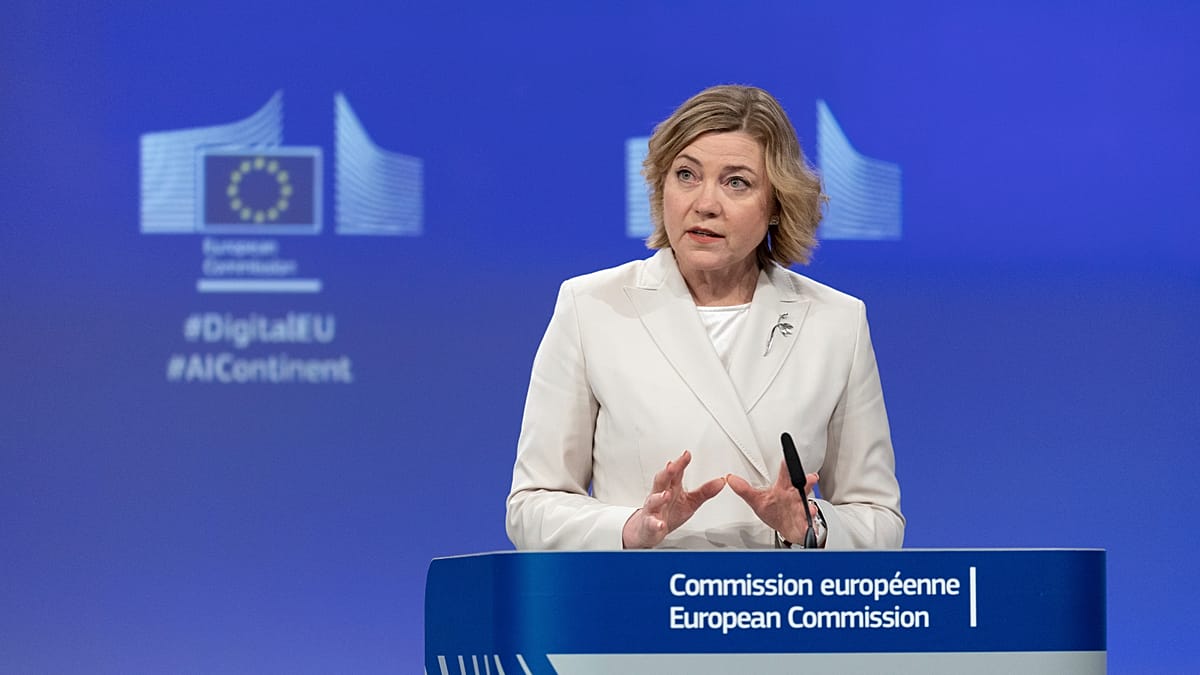
“We live in a world where geopolitics and technology are inseparable. Those who champion technological innovation will shape the future, and we must ensure that Europe plays a leading role in this,” European Commission Executive Vice President Henna Virkkunen said.
The package seeks to boost Europe’s domestic tech sector, with a heavy focus on cloud infrastructure, AI services, open source and chips.
In his landmark report on the languishing state of the European economy, former Italian Prime Minister Mario Draghi argued that most of the recent divergence in GDP growth between the EU and the US could be explained by digital technologies.
Having missed the first wave of the digital economy — the internet-driven services boom — Draghi warned that Europe’s last chance to rejoin the international tech race was not to be missed, namely the transformative potential of artificial intelligence.
While growing dependency on foreign technologies had been widely known among European decision-makers for decades, US President Donald Trump’s assertive trade agenda and China’s willingness to weaponise such dependencies have provided fresh momentum.
Will Brussels’ move be enough to shift the dial, or is it too little too late? And what will be the economic cost of severing deeply entrenched dependencies if the EU draws the ire of Washington and Beijing?
What’s in the package?
The main target of the European Commission’s proposal is the cloud sector, which provides the physical infrastructure underpinning most digital services. Amazon, Microsoft and Google account for 80% of the European market, with EU-based providers relegated to the margins.
The draft law introduces four different levels of digital sovereignty that public authorities must consider when purchasing cloud services, depending on how sensitive the use case is.
The highest tier, covering sectors such as defence and healthcare, would effectively bar non-European companies from winning public contracts. The aim is to prevent a so-called “kill switch” scenario, the risk that a foreign government might simply cut off access to hospitals or fighter jets.
For MEP Axel Voss (EPP/Germany), the Commission’s approach is both bold and pragmatic. “Building genuine European cloud and AI sovereignty is overdue, and giving our providers a fair seat at the table in strategic public tenders is the right instinct,” he said.
Europe also needs to catch up on chips — the fundamental components at the heart of almost every electronic device. The most advanced chips, used to develop cutting-edge AI technologies, are designed in the US and produced in Taiwan or South Korea.
After the first Chips Act failed to significantly bring semiconductor factories back to Europe through state subsidies, the Commission is trying again — this time focusing on stimulating demand for European chips, on the assumption that supply will follow.
Certain key sectors, such as automotive, will also be required to diversify their chip suppliers in certain circumstances, as part of a broader effort to reduce reliance on Chinese-subsidised producers accused of flooding the market through dumping.
Will it be effective?
The guiding principle of the initiative is AI — the transformative technology that, much like the internet before it, is reshaping the digital economy. Cloud data centres and chips provide the essential infrastructure for the next generation of AI.
Yet the AI market is dominated by the likes of OpenAI, Anthropic and DeepSeek. A European preference in lucrative defence contracts could serve as a lifeline for Mistral AI, the only EU-based company at the cutting edge of the AI race.
The EU lags significantly behind in data centre construction needed to meet expected demand for AI services in the coming years, held back by a mix of slow permitting, high energy costs and a scarcity of available land.
“Europe cannot regulate its way out of technological dependency,” MEP Matthias Ecke (S&D/Germany) told reporters. “It must build its own capacity, overcoming one-sided dependencies and restoring a genuine choice for businesses and consumers alike.”
At the same time, the EU is set to join a US-led initiative, Pax Silica, to secure chip supply chains, in recognition that Europe cannot do without Nvidia chips in the short term.
That dependency could nonetheless prove self-perpetuating: regulators and rivals warn that Nvidia tends to build a closed ecosystem that is difficult to break away from.
Will there be a backlash?
The concept of technological sovereignty originated in French defence circles, rooted in the idea of developing an autonomous nuclear deterrent. The debate spilled over into digital technologies — given their dual-use potential — during Trump’s first term.
A stark wake-up call for EU policymakers came when, after the International Criminal Court issued an arrest warrant for Israeli Prime Minister Benjamin Netanyahu, the US administration sanctioned several ICC officials — cutting them off from American services woven into daily life, such as Visa, Amazon and Uber.
As Washington has grown more explicit about weaponising critical dependencies, concerns about retaliation against any treatment of US firms deemed unfair have mounted.
Commission insiders, however, consider the US front largely pacified by the EU-US Turnberry agreement, which broadly favours the American side, and say the tone behind the scenes in recent weeks has been far more constructive than the public outbursts suggest.
On the China front, the tech sovereignty debate is just one thread in a far broader tapestry of strained relations between Brussels and Beijing, with discussions around a potential trade war reaching a fever pitch in recent weeks.
Both Washington and Beijing have weaponised strategic dependencies in what analyst Mark Leonard has called the Age of Unpeace. Yet neither superpower can afford to lose access to Europe’s main strength: one of the world’s largest and most lucrative markets.
Where is Europe headed?
In the complex chip value chain, Europe still controls critical chokepoints, most notably through Dutch company ASML, which holds a near-monopoly on the industrial machinery essential to chip production.
The package also includes a strategy to leverage open-source technologies, which could help the EU overcome its fragmented tech landscape — one that has yet to produce a company capable of directly competing with Silicon Valley’s giants with an integrated offering.
Still, the lack of a scalable European single market and access to capital are frequently cited by European start-ups as the main reasons they move abroad — issues the Commission is attempting to address through the EU Inc. proposal and the capital markets union.
In short, the EU faces structural problems dragging its tech sector back. The sovereignty package addresses some of them while attempting to leverage Europe’s own strengths, conscious that complete autonomy in a globalised world is unrealistic.
For instance, Japan coined the concept of “strategic indispensability,” which emphasises controlling critical leverage points.
“The target is to achieve something visible by 2030,” Virkkunen said. “80% of technology is coming from outside Europe. We will not change that overnight.”