

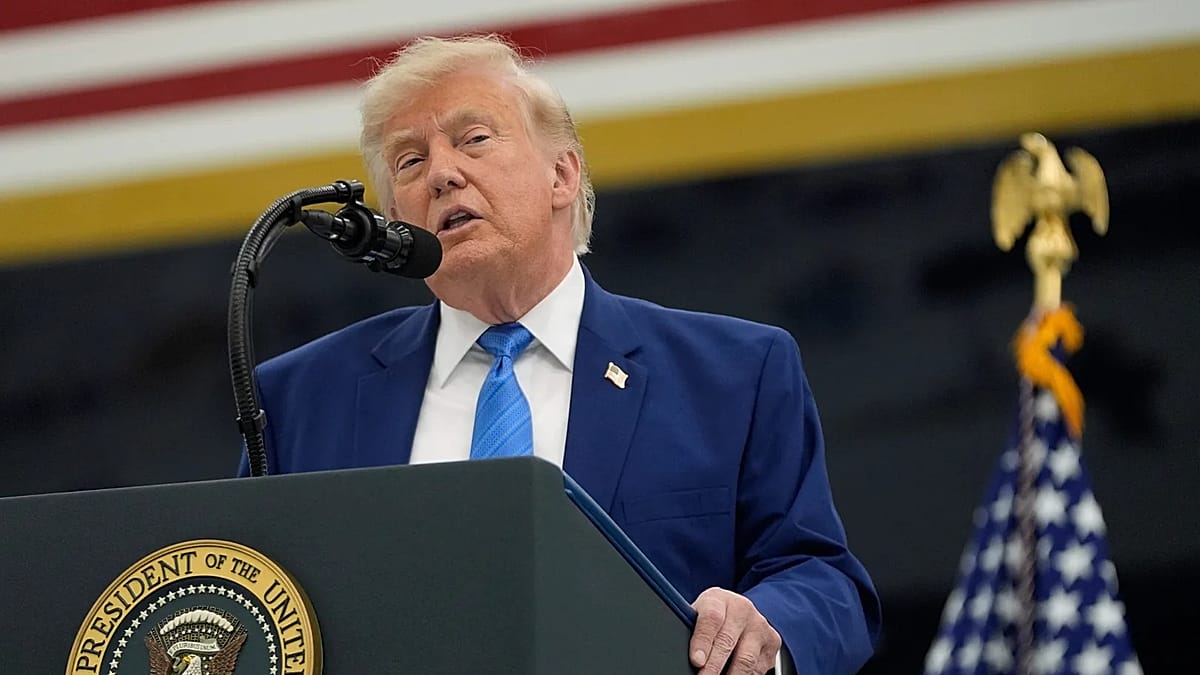

US President Donald Trump’s tirade against NATO has intensified in recent weeks against the backdrop of the war in Iran, going as far as threatening to pull out of the alliance after European countries and other Western partners refused to actively take part.
ADVERTISEMENT

ADVERTISEMENT
His latest verbal assault, in which he called the alliance “paper tiger”, came after NATO countries didn’t respond to his calls to assemble a naval force to help reopen the Strait of Hormuz, which Tehran has effectively blocked.
“I would say [it’s] beyond reconsideration,” he said in an interview with UK newspaper The Telegraph. “I was never swayed by NATO. I always knew they were a paper tiger, and [Russian President Vladimir] Putin knows that too, by the way.”
Trump’s comments have sparked confusion online as to how a country can launch the process to leave the alliance, with some saying it’s impossible and others claiming the US president can unilaterally decide to leave. So what do the rules say?
What does NATO say?
Article 13 of the 1949 North Atlantic Treaty says that, to leave, a country needs to formally notify the US, which then lets all the other members know. It will then officially withdraw a year later.
It therefore seems straightforward enough for European countries and Canada, subject to their own domestic laws and processes, but how could the US quit the alliance?
Under the North Atlantic Treaty, the US acts as both a member and the depositary of the alliance, meaning that it manages the treaty texts and handles accession and withdrawal notifications.
Essentially, the US government would have to notify the US Department of State of its intention to withdraw. It would then fulfil its usual obligation of letting all the other members know.
In theory, the US could remain NATO’s depositary without being a member, but the remaining countries would likely vote through an amendment to the treaty to give those duties to someone else.
What does US law say?
Domestically, things aren’t as simple for the US to leave, either. In 2023, then-President Joe Biden signed legislation blocking a president from quitting the alliance unless they’re backed by a two-thirds majority in the Senate.
It was an amendment to the National Defense Authorization Act for Fiscal Year 2024, specifically saying that the president cannot “suspend, terminate, denounce or withdraw” from the North Atlantic Treaty unless they have the Senate supermajority or an Act of Congress to do so. It also prohibits the use of federal funds to support a withdrawal.
“The law makes it formally very difficult for the president to take the US out of the treaty,” Rafael Loss, policy fellow at the European Council on Foreign Relations, told Euronews’ fact-checking team, The Cube. “Of course, there might be — in the case of Trump trying to do so — differing legal interpretations of the competencies of the US’s different legislative branches.”
It’s highly likely that any decision to formally withdraw from NATO would head straight for the Supreme Court, with the government arguing that the power to leave a treaty belongs to the president and that attempts to stop that are unconstitutional.
“There are also other NATO-related statutes in the US, such as those mentioning US contributions to NATO’s budget, requirements to appoint personnel, export controls and other policies,” Loss said, adding that as the US is mentioned in name by NATO treaties, any departure by Washington would trigger litigation and questions over those laws in the US.
Remaining in name only
A major concern, however, is a scenario in which the US technically remains in NATO but effectively leaves by severely reducing its contributions to the alliance and abandoning its mutual defence obligations under Article 5 of the North Atlantic Treaty.
Experts warn that hollowing out NATO in such a way, especially given the US’s enormous supply of resources, could fundamentally damage the way it works.
“Trump can’t legally withdraw from NATO without Senate consent,” said Ian Bremmer, president and founder of Eurasia Group, in a post on X. “But if NATO members can’t trust that the United States will honor Article 5, the alliance is already broken in the way that matters most.”
Loss voiced a similar opinion, telling The Cube that, while the US formally withdrawing would cause “tremendous damage” to NATO, it would be preferable to remaining a non-committed member in some respects, because at least such a move would provide clarity and advance notice to the other members.
“We can’t exclude the possibility [that the US will stay as an indifferent member] given what Trump has said,” Loss explained, pointing to the president’s wavering on NATO commitments, his recent criticism of the US’s allies, and his comments about seizing Greenland from Denmark and annexing Canada — both fellow NATO members.
“Trump is not committed to the day-to-day operation of NATO, so it’s not outside the realm of capability that he says the US no longer feels bound by the Article 5 obligation,” he added. “It would be a difficult gap to close for Europe.”
With the US out of the picture, Europe and Canada would not only have to plug the huge hole left by Washington (the US contributed around 60% of NATO’s total $1.404 trillion defence spending in 2025), but they would also have to iron out an array of logistical issues.
These include critical vacancies left by US personnel, a loss of access to bases on US territory, and an inability to assess the involvement of the US in Europe in the future.
Has anyone left NATO before?
A potential “half exit” from NATO isn’t without precedent, however, with Loss pointing to France as an interesting case study.
While no country has ever left NATO before, the closest one came was when France, under President Charles de Gaulle, decided to withdraw from its military command structure in 1966.
In practice, it remained a member (specifically as part of the North Atlantic Council, NATO’s political wing), but thousands of US troops were ordered to leave France, and NATO’s headquarters moved from Paris to Brussels, where it remains today.
French generals also no longer reported to the Supreme Allied Commander Europe, who is always a US citizen.
Nevertheless, Paris returned to the fold in 2009 under President Nicolas Sarkozy, rejoining the military command.
NATO did not respond to our request for comment as of the time of publishing.