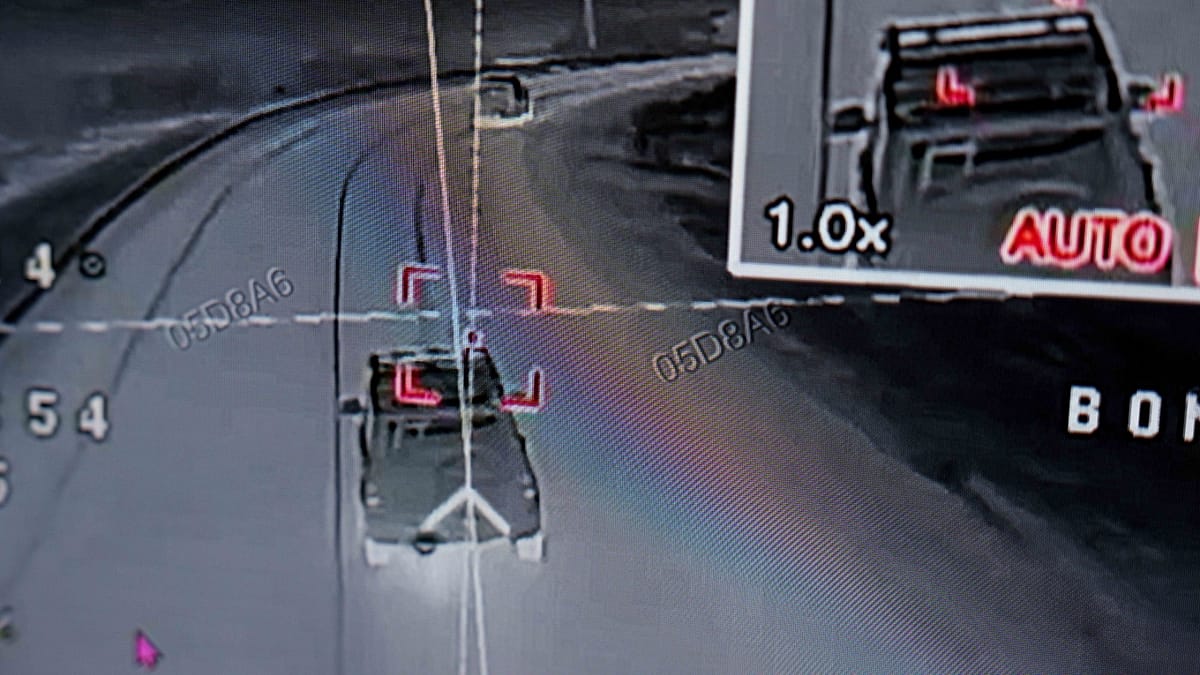


You may have come across a video that has been circulating widely on social media in recent weeks, showing what appears to be a portable military system intercepting a drone and sparking speculation about its origins.
ADVERTISEMENT

ADVERTISEMENT
A review of the accompanying captions reveals conflicting claims. Some posts describe the technology as a Ukrainian-made drone interceptor, while others insist it comes from Russia.
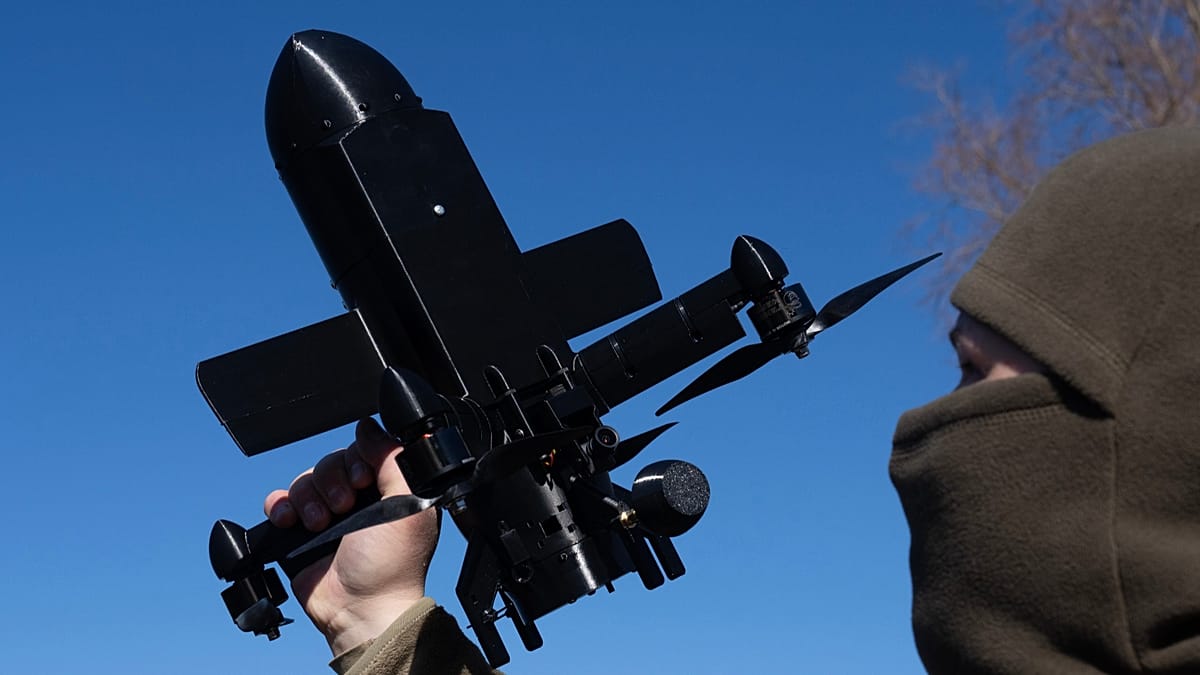
The claims attributing the system to Ukraine are misleading, as the device shown in the video is the Yolka drone interceptor, an unmanned aerial vehicle developed in Russia to counter small aerial threats.
It’s been used by Russian forces to intercept Ukrainian drones during Moscow’s full-scale invasion of Ukraine.
What is the Yolka drone interceptor?
The Cube, Euronews’ fact-checking team, spoke to experts who helped us identify the drone and exactly how it works.
David Bacci, senior researcher in aerodynamics at the University of Oxford, told us that the Yolka is a lightweight, portable interceptor designed to be operated by a single person.
“The operator launches it in a similar way to a rocket,” Bacci explained. “Its maximum speed is around 200 km/h, and it weighs less than two kilograms.”
According to Bacci, the interceptor initially relies on an electro-optical guidance system before switching to infrared guidance during the terminal phase of flight.
With an operational range of less than five kilometres, it is classified as a point-defence interceptor intended to neutralise nearby aerial threats.
Further details about the system emerged on 18 March, when Sergei “Flash” Beskrestnov, an adviser to Ukraine’s Ministry of Defence, outlined the interceptor’s technical characteristics on Telegram.
According to Beskrestnov, the Yolka can only operate during daylight hours and is unable to function effectively in rain. He also said its performance deteriorates in high-contrast cloud conditions and under direct bright sunlight.
Bacci reached a similar conclusion, noting that the interceptor destroys its target through direct impact rather than detonation.
“It simply collides with the target to bring it down,” he said. “Because it carries no warhead, its effectiveness is considered average, and it is not particularly useful against larger targets.”
The explosion visible in the footage does not appear to originate from the interceptor itself. Geert De Cubber, a research engineer at the Royal Military Academy of Belgium, told The Cube that the blast is more likely caused by the explosives carried by the Ukrainian drone being targeted.
“The Yolka does not carry a warhead,” De Cubber explained. “The explosion seen in the video can therefore be attributed to the payload of the intercepted drone.”
Ukraine has also developed comparable systems, including the Sting interceptor drone, which was specifically designed to counter Iranian-made Shahed attack drones used extensively by Russian forces.
How effective are interceptor drones?
De Cubbe told The Cube that interceptor drones have become an increasingly important counter-drone tool on both sides of the war.
“There are multiple interceptor systems in operation, including Ukrainian equivalents, and over the past few years they have proven to be a capable counter-UAS method,” he said.
However, De Cubber cautioned that videos circulating online may not provide a complete picture of their effectiveness.
“The interceptor may be relatively cheap, but that comes at a cost,” he explained. “The fewer sensors, processing capabilities, battery capacity and explosives an interceptor carries, the lower the probability of a successful hit.”
He also noted that both Russia and Ukraine rely on many of the same commercial components to manufacture drones, making key parts increasingly scarce and difficult to procure.
“The videos shared online only show successful interceptions,” De Cubber added. “They do not show the failed attempts, which makes it difficult to assess the true effectiveness of these systems.”
Bacci echoed this assessment, describing the Yolka as a system with only moderate effectiveness. Because it relies on direct impact rather than an explosive warhead, he said it is best suited to engaging small aerial targets and is generally ineffective against larger drones.
Origin of the clip
A closer look at the footage reveals a military insignia visible in one corner of the video. The emblem belongs to the Vakha Battalion, a sub-unit of Spetsnaz Akhmat, a Chechen formation fighting alongside Russian forces in Ukraine.
The Vakha Battalion confirmed to The Cube that it had originally filmed and published the footage.
Andre Zatirko, a journalist with the Polish public broadcaster TVP World who has investigated the Akhmat units, told us that the Akhmat Special Forces were established by Chechen leader Ramzan Kadyrov in March 2022 to participate in Russia’s full-scale invasion of Ukraine.
The formation is commanded by Apti Alaudinov, a close ally of Kadyrov and former first deputy interior minister of Chechnya. According to Alaudinov himself, ethnic Chechens make up only around a quarter of the unit’s personnel, with the majority recruited from other Russian regions. Despite its name, the formation also accepts volunteers with no prior military experience.
Mark Youngman, founder of Threatologist, an open-source investigative project specialising in Russian security and extremist movements, explained that the Vakha Battalion is one of several sub-units operating under the Spetsnaz Akhmat umbrella.
“Spetsnaz Akhmat has been the primary vehicle for organising pro-Russian Chechen involvement in the war against Ukraine,” Youngman said. “The formation is now subordinate to the Russian Defence Ministry and consists of volunteers both from Chechnya and from across Russia who have undergone training at the Russian University of Spetsnaz.”
According to both Youngman and Zatirko, Akhmat’s sub-units are typically named after their commanders. The Vakha Battalion is led by Vakha Saaev, a cousin of Apti Alaudinov.
Youngman added that, according to statements made by the battalion’s commander, the unit has been operating on the Kharkiv front since Saaev assumed command.