



During last month’s multinational exercise Grand Quadriga 2026, German troops in Seedorf weren’t just training with drones, they were also building them.
ADVERTISEMENT

ADVERTISEMENT
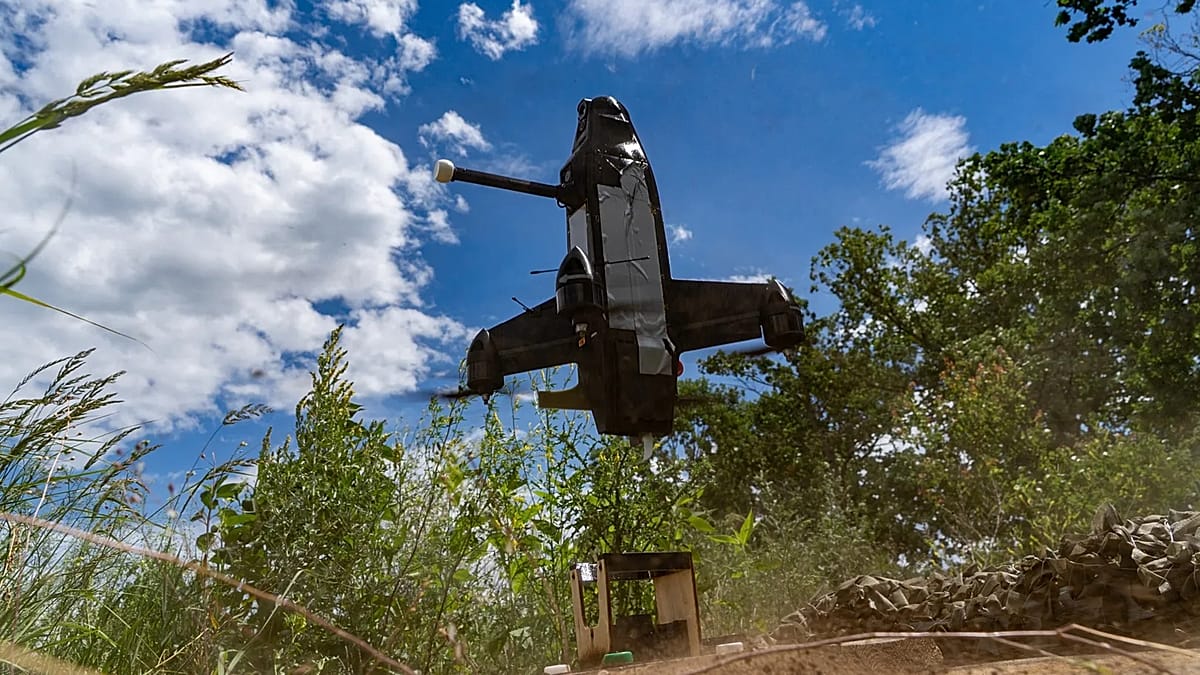
Instead of traditional live-fire drills, troops used reconnaissance drones, real-time data links and FPV systems to identify targets and engage them within seconds. FPV (first-person view) drones are unmanned aircraft piloted remotely fitted with an onboard camera, offering operators a live, direct view.
As part of the so-called “Spark Cells” programme, soldiers worked alongside the Bundeswehr’s Cyber Innovation Hub (CIHBw) to build, test and refine some of these small unmanned systems themselves.
The aim is to ensure they can adapt and repair them independently if needed. The German army uses the term “Spark Cells” to describe small, decentralised innovation units set up by the CIHBw.
Founded in 2017 and established as the army’s innovation unit three years later, the CIHBw is intended to speed up the introduction of new technologies into the armed forces. It works with soldiers, start-ups and companies, testing solutions directly in the field. Rather than relying on lengthy development cycles, prototypes are developed and trialled early with troops. Organisationally, it falls under the Federal Ministry of Defence.
Data as the new ammunition
Modern warfare is becoming increasingly digital and unmanned. Lessons from Russia’s full-scale invasion of Ukraine, and more recently from the Iran war, have underlined just how central drones have become to military operations. Ukrainian President Volodymyr Zelenskyy recently said Ukrainian forces had, for the first time, captured a Russian position using only unmanned systems, including drones and ground-based robots.
Speaking to Euronews, a spokesperson for the Cyber Innovation Hub of the Bundeswehr said drones are no longer just an add-on, but a “structurally defining element of modern warfare,” transforming reconnaissance, strike capabilities and decision-making cycles.
“Those who control airspace at a tactical level gain speed, transparency and precision at a strategic scale,” the spokesperson said. Modern warfare, he added, is “technology-driven, data-based and, above all, faster.”
In an interview with Euronews, Army Chief of Staff Lieutenant General Dr Christian Freuding described data as a central resource, calling it “a form of ammunition.”
“Those who can see more, and process information faster and more effectively, can build a clearer picture of the battlefield, make decisions more quickly and act with greater precision,” Freuding said. “In short: they win.”
This shift is not just transforming the German army, it’s redefining the role of the soldier. Today’s troops are expected not only to operate systems, but to understand, question and even refine them.
“Technological literacy, improvisation and networked thinking are now as vital as traditional skills,” the CIHBw-spokesperson said. In other words, the modern soldier is no longer just a user, but a co-developer.
‘The future doesn’t wait for authorisation’
This approach was put into practice during the exercise in Seedorf. Troops from Airborne Engineer Company 270 and Paratrooper Regiment 31 were not only training with drones, they were building them. Drawing on their understanding of individual components, soldiers developed their own FPV drones, assembling prototypes, testing them in simulators and in real-world conditions, and continuously refining them.
According to the CIHBw, the process involved 3D printers and commercially available electronic components. But beyond the technical aspect, officials say the shift reflects a broader cultural change. “What we are seeing is a move away from the soldier as a pure user towards an active designer,” the CIHBw spokesperson told Euronews.
“That’s a decisive factor for an adaptive and resilient armed force.” The reasoning is simple: speed. “The future doesn’t wait for authorisation,” the spokesperson said. “If there is a concrete problem in the field, the fastest way to find a solution is often the most direct one. Soldiers know their requirements best.”
Allowing troops to develop and test their own systems, they added, creates “speed and operational relevance.” At the same time, the German army stresses this is not about replacing industry, but complementing it. The goal is a “hybrid model”, combining centrally procured systems with decentralised adaptation and development within the force, while reducing dependencies and increasing flexibility.
According to the spokesperson, the key question is no longer whether soldiers should develop their own solutions, but how to organise them effectively. The Bundeswehr’s Cyber Innovation Hub acts as a bridge between troops, technology and start-ups, helping turn ideas from the field into workable solutions.
So-called “Spark Cells” are designed to ensure innovation does not only come from the top down, but also from within the ranks. These units identify needs early, test solutions and feed successful approaches back into the system.
At the same time, officials stress that in-house developments must remain aligned with formal procurement processes. There are limits, particularly when it comes to highly sensitive or complex systems, but within those boundaries, the aim is to give soldiers greater room to innovate.