
The blame for the fact that wars continue to be waged cannot be laid at the door of the United Nations, the President of the United Nations General Assembly (UNGA), Annalena Baerbock, told Euronews.
ADVERTISEMENT

ADVERTISEMENT
Instead, the finger should be pointed at member states, she argued.
“If a member state starts a war of aggression, then it’s not the UN [that is] failing, or the Charter [that] is not being clear enough that this [war] is not allowed, but it’s the member state, who is in full awareness of breaching the Charter in pressing forward with this war,” Baerbock said on Euronews’ interview programme 12 Minutes With.
“This is why the UN needs the counter-pressure from other member states as well,” the former German foreign affairs minister added.
The UN has, in recent years, faced mounting criticism, including from its member states, for what some see as an inherent failing to fulfil its core mandate of maintaining international peace and security.
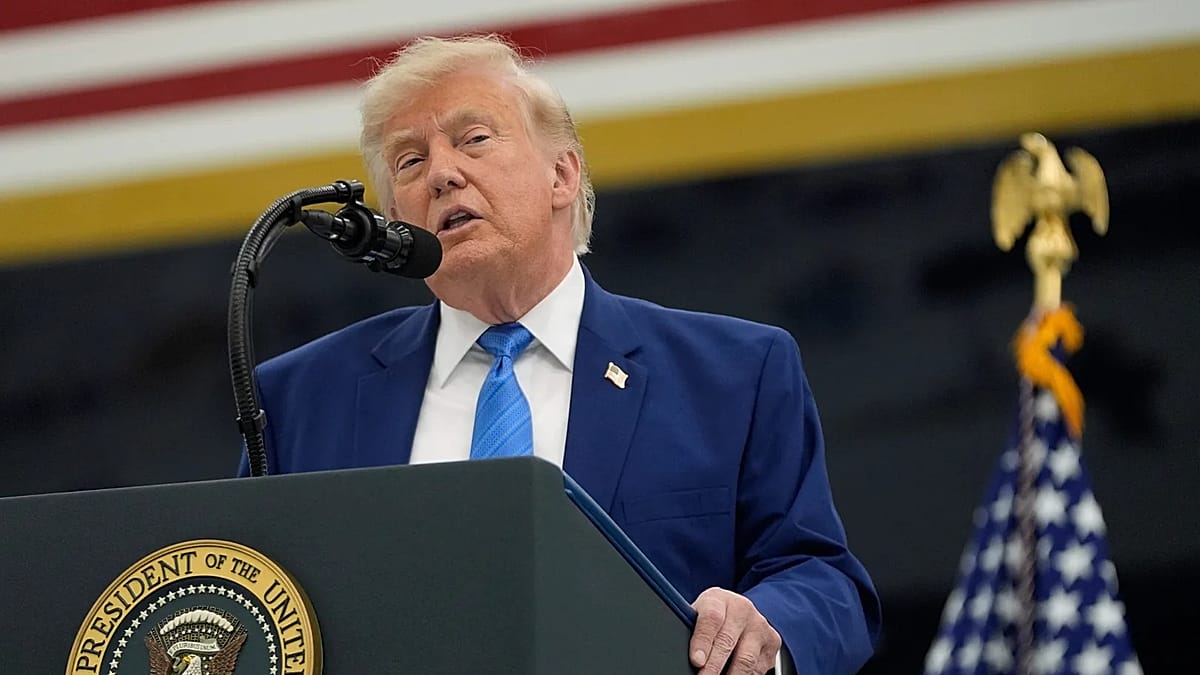
In an address to the UNGA last year, United States President Donald Trump charged the organisation with failing to act to solve spiralling conflicts, denouncing what he said were “empty words” that “don’t solve war.”
However, Baerbock noted that the UN is not a single actor, but a collection of 193 “very diverse member states.” She added that, in that sense, the UN’s work is similar to that of national judicial systems, which also rely on multiple players.
“We have clear rules that you should not kill anybody. Unfortunately, murder still happens,” she said.
“But nobody would say, ‘Okay, we should just get rid of the criminal code now, because we could not prevent the murders’. Police and society [must also] counter it, and it’s the same for the UN. We heavily depend on the member states.”
Veto problem
According to Baerbock, the main obstacle for the UN to address today’s conflicts lies in the veto powers some of these members hold within the Security Council, the organ tasked with maintaining international peace and security.
China, France, Russia, the United Kingdom, and the United States — known as the “Permanent Five” (P5) or “Permanent Members” — hold permanent seats and veto power, allowing them to block any UN resolution.
This veto accorded to a select group of members has, in recent years, generated much controversy, as it significantly hinders the council’s ability to reach international peace.
In recent years, Russia and the US were the main drivers of this paralysis, blocking actions related to Ukraine and the situation in Gaza, respectively. In 2024, permanent members cast eight vetoes on seven draft resolutions, the highest number since 1986. Last year, the Council saw two US vetoes on Gaza and two Russian vetoes on Ukraine.
“Unfortunately, in these times, member states do not all take up their responsibility, but [instead] even use their veto rights to defend the breach of international law,” Baerbock said.
“If you use a veto in a way that we cannot come to a decision in the Security Council and then you complain that you could not come to an agreement, obviously it’s also the responsibility of those who are casting a veto.”
This Security Council logjam reignited calls for significant reform to curtail this power, as well as expand permanent representation to Africa and Latin America.
In March 2025, UN Secretary-General António Guterres launched the UN80 reform initiative to mark the organisation’s 80th anniversary. It aims to streamline the UN’s structure, mandates, and finances, and includes efforts to limit the UN Security Council veto power.
However, there is little appetite among the P5 to undertake reforms that might dilute their power or influence. “And unfortunately, it needs the agreement of all the members of the Security Council.”
Some fear the UN faces another threat created by the US, namely the so-called Board of Peace. It was originally approved by the UN Security Council as an oversight mechanism for the ceasefire in Gaza, but Trump hinted during the Board’s launch that it could morph into something bigger.
Baerbock, however, brushed aside concerns that the Board of Peace could become a contender for the UN.
“There’s a good reason that at the UN every member state, no matter how big or small, how powerful, has an equal seat at the table. This is a unique responsibility and also the unique role the UN can play,” she said.
“Member states made very clear, also those who joined the Board of Peace, that this is only concerning Gaza and for any other matter on peace and security, it will remain, for good reasons, the United Nations, where you don’t have to pay.”
Unlike at the UN, countries invited to join the Board of Peace can participate at no cost for up to three years, but must contribute $1 billion (around €852.1 million) each to stay on past that initial term.