Good morning. Angela Skujins penning this Thursday’s newsletter from the Belgian capital, where I can say with quiet confidence that everyone not enjoying the public holiday has their eyes firmly fixed to what is happening nearly 8,000 kilometres to the east.
ADVERTISEMENT

ADVERTISEMENT
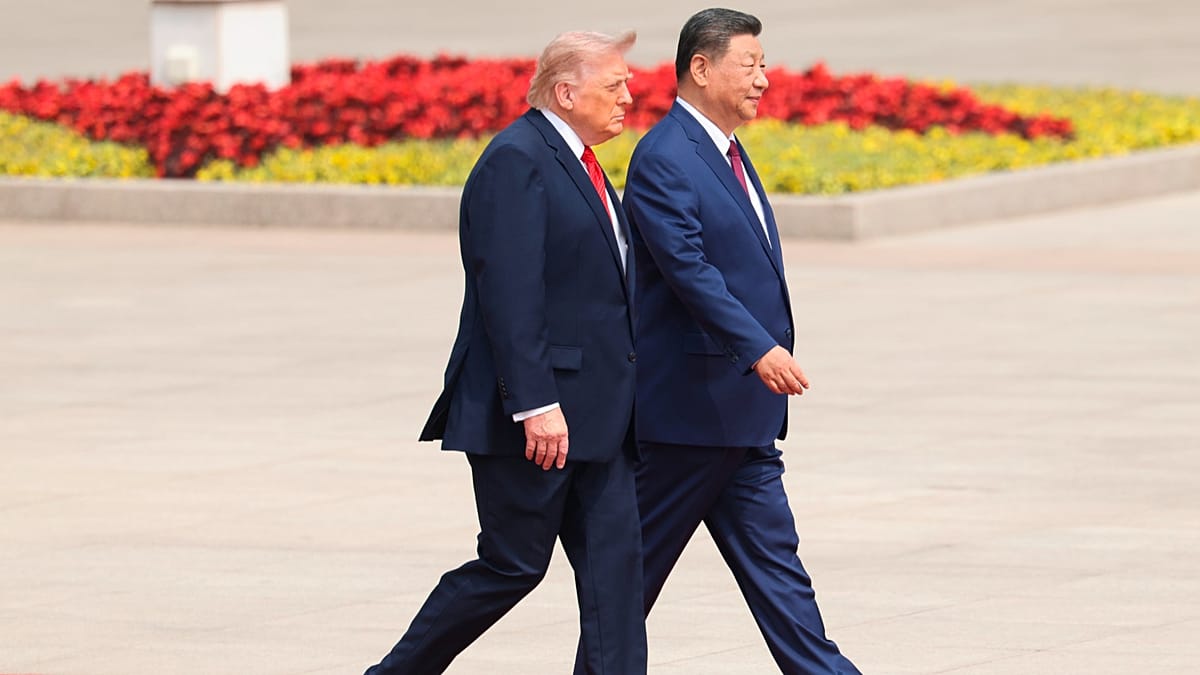
Before US President Donald Trump departed the White House on Tuesday for an almost 14-hour flight to the Chinese capital, he outlined in plain English the importance of the visit. “We’re the two superpowers,” he said unabashedly.
“We’re the strongest nation on earth in terms of military. China’s considered second,” Trump said.
After landing, both presidents expressed hope that the meeting – seen as the most consequential bilateral of 2026 – would bear fruit regarding the Iran war, trade and Taiwan.
But Xi warned of how the meeting could be perceived from the sidelines, and asked his counterpart whether the two countries can transcend the ‘Thucydides Trap’ and “forge a new model for relations between major powers.”
He was referring to the idea that when a rising power threatens to displace an established power, the result is often war. “It’s an honour to be with you. It’s an honour to be your friend,” Trump countered.
As Stefan Grobe writes, Europe is watching all this from the periphery, wondering how the continent will be squeezed between the superpowers, if at all.
Rare earths are the major sticking point here, with China maintaining a stranglehold of 17 rare earth elements used for the production of crucial technologies. The issue is that Beijing can – and has – turned off supplies like a tap. Much like Brussels, Washington covets these minerals.
The nightmare scenario for Europe is that Trump, who travelled to Beijing under the darkest economic clouds of his political career, strikes a deal that leaves the bloc in the dust. Experts can’t exclude this as a potential outcome.
“Realistically, the Trump-Xi talks are becoming very bilateral,” said Jonas Parello-Plessner, a visiting fellow in the Indo-Pacific programme of the German Marshall Fund (GMF). “And one thing is certain: Trump will only speak for himself.”
Member of the European Parliament Michael Bloss sits on the delegation responsible for Brussels-Beijing relations. He just told Europe Today that Europe has to realise it is not sitting at the table during these talks which could impact its future – and that the continent’s survival relies on speaking with one, strong voice.
“China is doing this divide and conquer policy,” he said, “but the question is, for us, how do we get more autonomy and more sovereignty?”Watch.
The debate regarding reliance is also heating up at home.
As Marta Pacheco reports, energy ministers in Cyprus on Wednesday confronted Europe’s dependence on China’s power storage dominance.
Chinese firms now control the vast majority of Europe’s battery energy storage system market, accounting for more than 80% of the residential storage segment and nearly 88% of lithium-ion battery imports, according to global research data firm Wood Mackenzie.
Analysts say Europe could reduce its strategic dependence on China in clean energy industries, but replacing Beijing across the entire supply chain is probably unrealistic within the next decade.
“While there has been a considerable drop-off in investments by Chinese energy companies since the late 2010s, as well as greater scrutiny of Chinese foreign direct investment in general, the legacy of Chinese involvement in the energy system persists,” a paper from the EU Institute for Security Studies states.
EU Commission to dispatch team to Budapest as it mulls Hungarian investment bank for EU cash
The European Commission is looking for ways to help Hungary unlock billions in EU funding, dispatching a delegation to Budapest next week as the clock ticks.
Brussels has warned Budapest that receiving the full €10 billion in recovery funds before an August deadline will be difficult, suggesting that it may receive the full grants, but not the loans. Still, the Commission will send a team of senior officials to make a more detailed assessment with the now-in-office government.
As Sandor Zsiros and Luca Bertuzzi investigate, one of the options the Commission is exploring is using the country’s investment bank Exim Bank to channel the funding, but Brussels also worries that it will lose oversight of the process, which is seen as imperative as the root cause for the blocked funding is the rule of law.
As it stands, Hungary will only receive cash in upfront payments if it manages to meet the criteria set out by the Commission, but time is tight. Nonetheless, employing the Hungarian investment bank as a vehicle for future projects would allow disbursements to proceed even if not all conditions are met upfront.
End ‘barbaric’ conversion practices now, Brussels tells EU countries
EU countries must take swift action to end “barbaric” and “shameful” conversion practices targeting LGBTQI+ people, Hadja Lahbib, the European Commissioner for Equality, said in response to a citizens’ initiative that gathered over one million signatures.
As Jorge Liboreiro and I report, conversion practices encompass interventions, such as psychotherapy, medication, electroshock and exorcism, aimed at changing a person’s sexual orientation, gender identity or gender expression.
They often involve abuse, violence and humiliation. “It’s a torture and it’s physical and psychological harassment that could lead to deep depression or suicide,” Lahbib told Euronews. A recommendation will be formally presented next year. This, however, falls short of the EU-wide ban that the citizens’ initiative demanded the Commission propose.
Lahbib admitted a lack of unanimity among member states. Article 19 of the EU treaties dictates unanimity to approve laws that tackle discrimination, including on grounds of sexual orientation. An equality directive has been stuck since 2008.
“We didn’t want to take decades of discussions like we are doing with the Equal Treatment Directive,” Lahbib said.
“So we prefer to build on goodwill, on awareness and on the fact that if we still believe that our union is a union of freedom, of expression, of equality, we need to ban this.”
Read more.
More from our newsrooms
Lost 9th-century manuscript containing earliest English poem found in a Rome library
In the archives of a Roman library, researchers have made an astonishing discovery: a 9th-century manuscript copy of the oldest known poem in the English language considered missing, until now. Theo Farrant looks at the literature.
Ryanair issues angry statement against German airport operator while calling to end its ‘monopoly’
The low-cost Ryanair airline has accused German-based airport operator Fraport of keeping a tax cut provided by the Greek government to itself, and also calls on Athens to topple “Fraport’s monopoly”. Ioannis Karagiorgas has more.
We’re also keeping an eye on
- European Commissioner for Defence Andrius Kubilius will travel to Zagreb, Croatia to finalise the country’s €1.7 billion EU defence loan.
- European Commissioner for Enlargement Marta Kos will meet with UK Minister of Europe and North America Stephen Doughty in London, UK.
That’s it for today. Marta Pacheco and Jorge Liboreiro contributed to this newsletter.