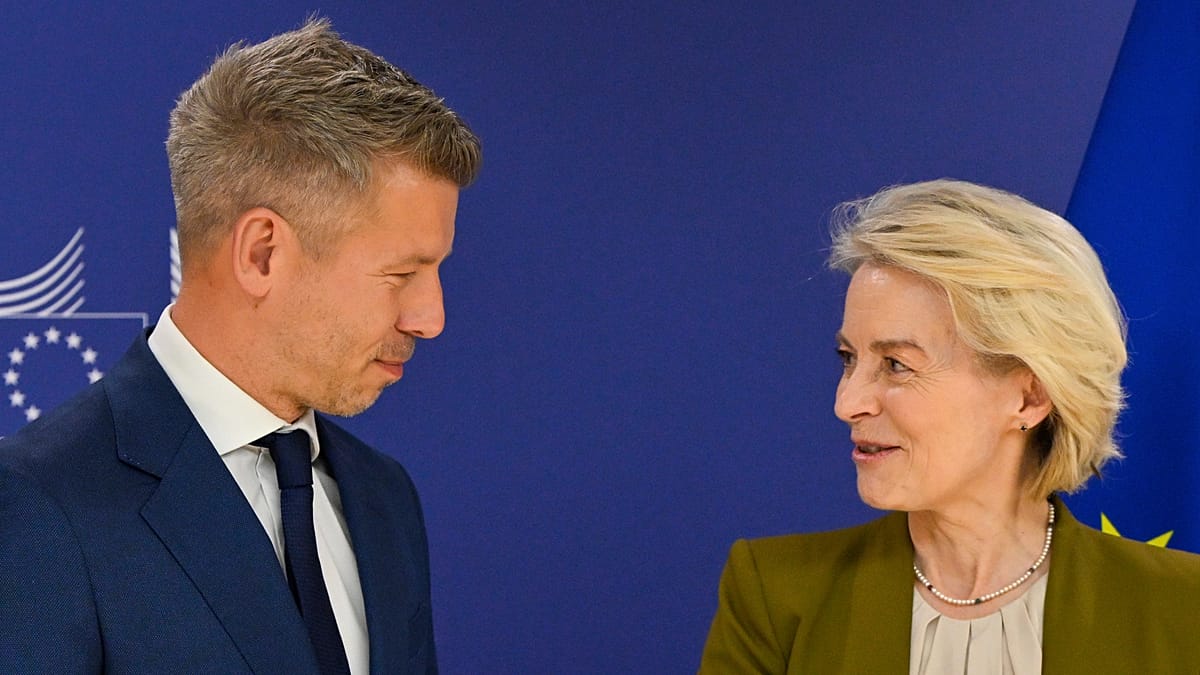


Hungary’s incoming Prime Minister Péter Magyar could shape not only domestic policy but also the future of Europe’s energy ties with Russia, after winning the 12 April election and promising to eliminate his country’s dependency on Russian energy imports by 2035.
ADVERTISEMENT

ADVERTISEMENT
Magyar has also pledged to align Hungary more closely with EU efforts to diversify oil and gassupply, a process the EU launched in 2022 following Russia’s invasion of Ukraine.
But even though shifting away from outgoing Prime Minister Viktor Orbán’s reliance on Russian oil could accelerate the region’s move away from Moscow, it will not come without economic and logistical challenges.
“The geographical position of neither Russia nor Hungary will change. Our energy exposure will also be here for a while,” Magyar told local media a few days before the election.
“Diversification needs to be strengthened, but this won’t happen overnight. If necessary, we will negotiate (with Russia), but we won’t become friends,” the Hungarian hailing from the Tisza Party added.
Magyar said that he would reassess financing for the Paks II nuclear project, a major Hungarian expansion project which is being developed in cooperation with Russia, while also exploring the potential to accelerate the deployment of smaller, more affordable modular reactors in collaboration with partners such as France and the United States.
For years, outgoing Orbán has steered Hungary along a distinct path within the EU, maintaining strong energy links with Moscow even as much of the bloc has worked to cut dependence on Russian oil and gas following the war in Ukraine.
Under Orbán, Hungary’s position had largely conflicted with the EU’s energy transition goal, raising questions about whether the new leadership would remain a weak link in the bloc’s energy strategy.
The country imported roughly 100,000 barrels of Russian crude per day in 2025, according to analysts at S&P Global Energy CERA, accounting for around 90% of its supply.
Investment and infrastructure
The energy shift touted by Magyar, however, would not be immediate, as analysts say replacing Russian energy will require years of investment in new infrastructure and alternative sources.
“Hungary can, from an infrastructure standpoint, phase out Russian crude over the long term. However, doing so would come at a significant financial cost. Domestic fuel supply could be maintained, but the profitability of MOL Group—the country’s sole refiner—would decline,” Victoria Grabenwöger, senior analyst at data intelligence firm Kpler told Euronews.
Dimitar Lilkov, a senior research officer at the think tank Wilfried Martens Centre for European Studies, pointed to an analysis that shows that Hungary has full access to alternative supply routes and refineries capable of processing non-Russian crude.
The Croatian Adria pipeline, also known as Janaf, is one of these avenues, Lilkov said, even with potential lower transit costs.
“Alternative options are also available for natural gas. Such a pivot cannot happen overnight, but is perfectly realistic given that there is political will in the years to come,” Lilkov told Euronews.
“Péter Magyar has already signalled that this diversification would be pursued by the new government, so we can be hopeful that Hungary finally escapes the Russian energy chokehold,” Lilkov added.
While Orbán had argued that alternatives are more costly, the Croatian Economy Minister Ante Šušnjar hailed the Adriatic pipeline as a “reliable and credible route for regional energy security”.
“Our infrastructure is here to strengthen resilience, diversification and security across Central Europe. And our message to the Hungarian people is equally clear – Croatia extends a hand of friendship. We want cooperation, not confrontation. In a time of uncertainty, good neighbors build solutions together,” Šušnjar wrote on X on 12 April.
Exemptions to Russian energy imports
Due to their landlocked positions and difficult access to alternative energy suppliers, Hungary and Slovakia secured exemptions that allow continued imports of Russian pipeline oil until September 2027.
However, the EU is pushing to eliminate Russian gas imports by 2027, including phasing out these exemptions with a full ban on Russian natural gas scheduled for 30 September 2027.
It remains to be seen whether Magyar will challenge this position, given Hungary’s landlocked geography and its exposure to energy constraints exacerbated by the wider energy crisis triggered by the war in Iran, which has raised fears of supply shortages.
A ban on Russian oil imports was also to be proposed by the Commission on 15 April, but the EU executive decided to postpone it, a decision linked to the global energy crisis and a political row over the Druzhba pipeline.
Druzhba pipeline
Hungary’s landlocked geography and Soviet-era infrastructure have left it reliant on pipelines such as Druzhba and TurkStream, ensuring a steady flow of crude and natural gas from the east.
But damage to the Druzhba pipeline, which serves as a critical conduit for Russian oil to Slovakia and Hungary via Ukraine’s territory, has been another contested political issue leading up to the 12 April elections.
The Soviet-era pipeline has been damaged since 27 January, with Ukraine saying that a Russian airstrike damaged it. Russia denied it while Hungary and Slovakia complained about Ukraine’s unwillingness to repair the damaged pipeline, arguing they were suffering from “political blackmail”.
The Adria pipeline has effectively ensured “uninterrupted supply to both Hungary and Slovakia” over the past few weeks, Minister Šušnjar said. However, with Druzhba flows halted, Hungary has pushed to import Russian oil by sea via Croatia, but it has yet to get approval from the pipeline operator.
The Druzhba pipeline has become shrouded in uncertainty, with EU officials being extremely coy about sharing details of the EU mission sent to Ukraine to assess the situation.
The Commission asked Ukraine to allow inspectors to oversee the damage to the pipeline, in line with a key demand from Hungary’s Orbán, which has maintained a veto on a critical €90 billion loan to Ukraine until the pipeline resumes operations.
Yet Ukrainian President Volodymyr Zelenskyy said on 10 April that the Druzhba pipeline was getting repaired and was expected to be fixed “this spring”.
Meanwhile, Slovakia’s Prime Minister Robert Fico, a longtime ally of Orbán who has been insisting on the quick resumption of oil flows through Druzhba, suggested Magyar should be interested in fixing the pipeline.
“I believe there remains a strong interest on the part of Slovakia, Hungary, and Central Europe as a whole in restoring the operation of the Druzhba oil pipeline,” Fico said on X, after the Hungarian elections.
Last September, Slovak Economy Minister Denisa Saková discussed the call to end Russian supplies via the Druzhba pipeline with US Secretary of Energy Chris Wright, explaining that Slovakia needed conditions for diversifying its supply so it would not cut off its economy or industry.