
Poland’s ambitious push to build a hydrogen-powered public transport system is faltering, with several buses halted by soaring fuel costs and fragile infrastructure, according to a new report by the NGO Central and Eastern Europe Bankwatch Network.
ADVERTISEMENT

ADVERTISEMENT
Polish municipalities embraced hydrogen buses largely because subsidy schemes covered up to 100% of vehicle purchase costs, while electric buses typically received only 60–80% support, according to the report. But once hydrogen buses entered service, operators discovered the fuel was dramatically more expensive than electricity.
The analysis argues that hydrogen buses were promoted as a shortcut to green transport, backed by generous EU and state funding, but many municipalities are now retreating toward battery-electric alternatives after confronting prohibitive fuel costs and the lack of refueling stations.
Cities like Rybnik reported that hydrogen fleets were more than three times as costly as diesel and four times as costly as hybrids. In Rzeszów, fuel costs over 15 years were projected to exceed the purchase price of the buses themselves, the CEE Bankwatch Network report states.
By the end of April, Poland had 247 hydrogen buses in total, either deployed or contracted by municipalities. 140 buses are already in service, while 107 have been contracted but not yet deployed.
Despite high hydrogen ambitions, Poland had only nine hydrogen refueling stations by the end of 2025 against the 32 envisaged by the government’s 2021 hydrogen strategy. In comparison, the country boasts more than 12,500 electric charging stations by early 2026.
Questioning ‘zero-emission’ buses
Under EU rules to make public buses cleaner and less polluting, every EU country must ensure that some of the buses they buy for public transport use cleaner energy rather than traditional diesel.
This means that when cities or transport authorities purchase new buses, a certain number must run on cleaner technologies such as electric batteries or hydrogen, or use lower-carbon fuels like biofuels.
EU officials touted hydrogen as a flagship technology capable of decarbonising transport while supporting a domestic hydrogen economy. But the technology’s high fuel costs, limited renewable hydrogen supply and immature infrastructure exposed deep structural weaknesses, at least in Poland.
The report also raises concerns about whether buses powered by non-renewable hydrogen should count as “green” public transportation, given that over 97% of the fuel is produced from fossil gas. The NGO argues that hydrogen buses are labeled “zero-emission” only because they emit no tailpipe exhaust, while ignoring emissions associated with their fossil fuel generation.
“Polish hydrogen buses were widely presented as clean and zero-emission, but in practice the fuel was mostly fossil-derived and even the limited electrolytic hydrogen did not meet strict EU renewable standards,” reads the study, referring to Poland’s use of biomass-generated electricity, which the report argues that it does not qualify as “green energy”.
Battery-electric buses, by contrast, advanced rapidly in range, charging infrastructure and economics during the same period, the report argues.
Poland’s electricity sector is rapidly shifting from coal to renewables like wind and solar. According to the energy think tank Ember, renewables generate about 30% of electricity, though coal still accounts for roughly half of the country’s electricity production.
Cities including Wrocław, Płock and Żory revised procurement plans after concluding electric vehicles offered lower risk and lower costs, the report claims. Kraków also scaled back its hydrogen ambitions due to uncertainty over fuel supply and infrastructure.
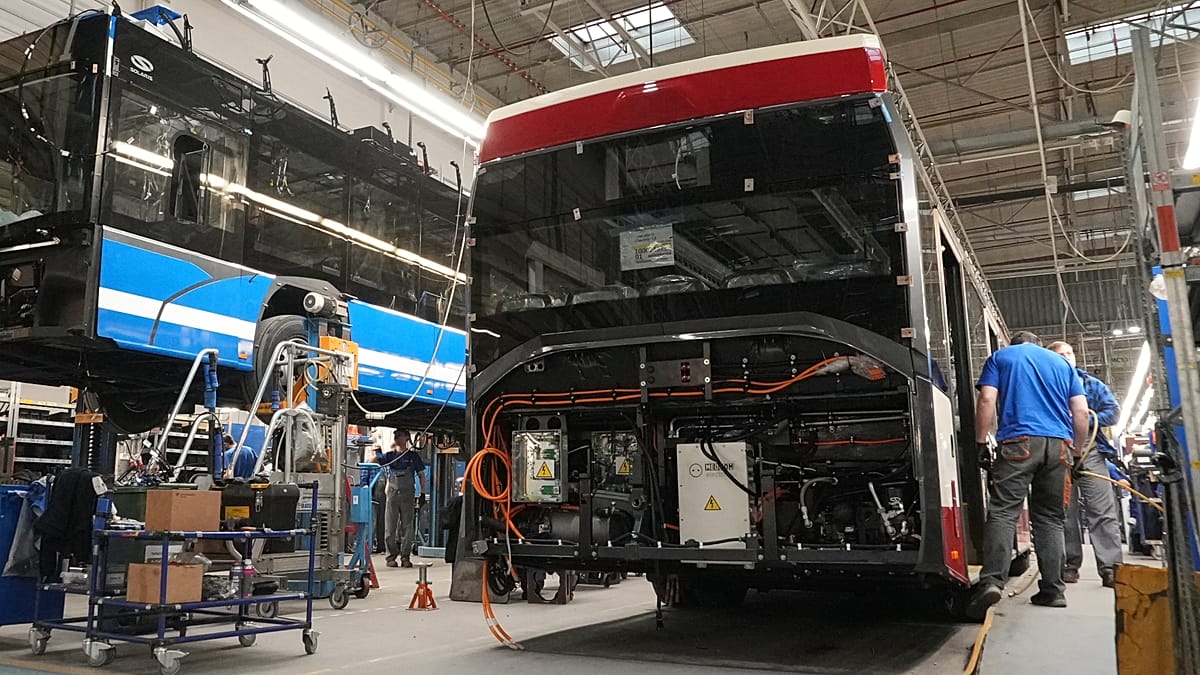
Polish automakers Solaris Bus & Coach and NesoBus have deployed numerous hydrogen and electric vehicles in cities such as Poznań, Konin, Lublin and Wałbrzych.
Dodgy funding
Despite the challenges, the Polish government received on 23 April a new batch of EU funds amounting to €7.2 billion, of which €500 million is intended to unlock hydrogen investments, particularly to boost private sector growth in renewable and low-carbon hydrogen production, according to the European Commission.
With EU grants, Warsaw is considering deploying more than 1,000 electric or hydrogen buses and trolleybuses to accelerate the shift to clean public transport. Questions remain whether the government will prioritise electric or hydrogen buses.
The Polish government didn’t respond in time to a request for publication from Euronews.
The CEE Bankwatch Network claims projects involving the procurement of hydrogen buses or the development of hydrogen refuelling stations have received more than €120.7 million in non-repayable grants and nearly €6.08 million in loans, backing the deployment of 163 buses and two stations.
On top of that, 73 fuel-cell electric buses and one refueling station were funded through projects that also included battery-electric buses, charging infrastructure and other investments, which the NGO claims make it impossible to determine the precise share of funding allocated specifically to hydrogen-related components.
“Hundreds of millions of euros from EU public funds spent to artificially create demand for hydrogen in Polish public transport could and should have been used to deploy real, try-and-tested solutions which already offer benefits to local communities and the climate,” said the report’s author, Diana Maciaga.
Germany’s successful hydrogen story
Contrary to Poland, Germany emerges as a hydrogen success story, currently operating over 600 hydrogen-powered public transport buses. The country will soon receive an additional 19 hydrogen buses, after the Polish Solaris Bus & Coach won a tender on 4 May.
Solaris has delivered over 800 hydrogen buses serving passengers in dozens of cities across Europe, with Germany leading the market. France, Italy, the United Kingdom and the Netherlands have also deployed a considerable number of hydrogen buses over the past years.
Laurent Donceel, director for transport, sustainability, and industrial policy at the trade body Hydrogen Europe, said that Poland’s early-stage struggles to secure a clean hydrogen supply are “completely normal” given that the country is just getting started in a nascent industry.
The industry group recognises Poland as the “leading EU country in fuel bus production” adding that the potential of all clean-tech transport solutions should be explored, given Warsaw’s crucial role in road transport for the country’s economy.
“With proper incentives and regulatory support at the EU and national level, it will not take much time for it to catch up to countries like Germany. It’s also worth noting that with Poland’s current coal-heavy energy mix, clean hydrogen remains the best decarbonisation option,” Donceel told Euronews.