

The EU’s next long-term budget, the Multiannual Financial Framework (MFF) covering 2028 to 2034, was billed as a historic overhaul. In practice, experts say it falls short.
ADVERTISEMENT

ADVERTISEMENT
With a headline envelope of roughly €1.8-2 trillion, the Commission’s proposal is the biggest in the Union’s history. But after repayments on NextGenerationEU pandemic debt, the effective new spending power shrinks to around 1.15 percent of EU gross national income, barely above the current framework. The bloc is asked to take on defence, industrial competitiveness, climate transition, enlargement, and support for Ukraine.
“It is not a budget fit for the union we have today,” says Eulàlia Rubio, Senior Research Fellow at the Jacques Delors Institute. “It’s a budget that would work very well for a more unified union, with a stronger sense of political unity. We don’t have that,” she told Euronews.
The budget “needs a fundamental rethink and I think I align with the Commission on that. We needed to put everything on the table and reshape or rethink the way we use the EU money,” says Rubio, reflecting the verdict from think tanks, the European Court of Auditors, and the European Parliament.
The MFF needs a rethink that goes beyond the reallocation of funds. It needs a redesign of how money is planned, financed, and governed.
A new architecture, but at what cost?
The Commission’s centrepiece reform is to merge cohesion, agriculture, and regional funds into a single National and Regional Partnership Plan for each member state. Supporters say it simplifies a complex system. Critics say it “nationalises” EU funds, giving governments discretion to redirect them away from poorer regions or climate projects and weakening parliamentary oversight.
The European Court of Auditors has flagged “multiple risks to sound financial management,” warning that relying on national control systems with known weaknesses could undermine transparency and accountability.
For Rubio, the problem runs deeper than where the money goes; it’s about how it is planned and spent. “We need to make sure that the projects selected are the best ones, the ones that help most to achieve EU priorities,” she says. “Change has become the norm. So, we need more flexibility, and we have to change the way of holding policymakers accountable for that flexibility.”
The own-resources mirage
To ease pressure on national contributions, the Commission has proposed five new revenue streams: levies on emissions trading, carbon imports, e-waste, tobacco, and large companies. But Zsolt Darvas, Economist and Senior Fellow at Bruegel, warns against over-optimism.
“Many people believe that such new own resources would generate some new revenues to the EU budget without a burden on national budgets,” he says. “I’m afraid this is not correct.” Four of the five streams, he argues, would simply reshuffle money already flowing through national treasuries, not create genuinely new fiscal space.
Darvas singles out the corporate levy, based on company turnover, as “the worst of the five proposals” because it would disproportionately burden lower-margin sectors like retail. He sees the Carbon Border Adjustment Mechanism as having the best chance of approval. But the political fragility is real, all five proposals require unanimity and national ratification, so any single member state can block them.
Three-way gridlock
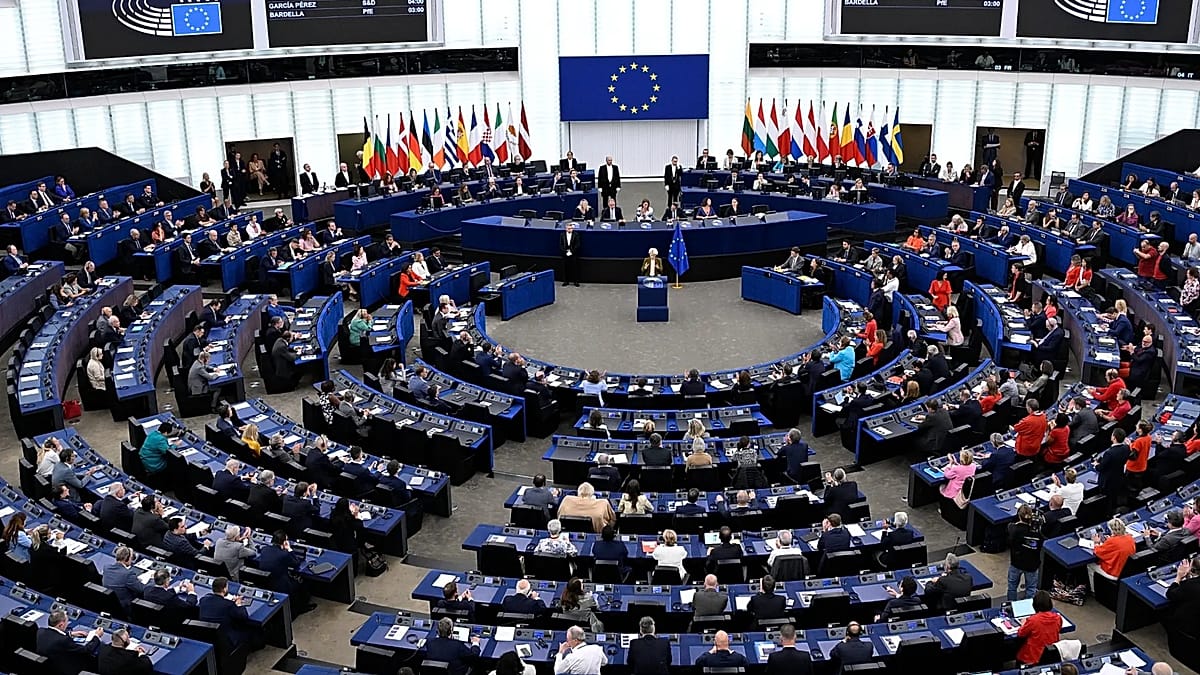
The European Parliament demands roughly €200 billion more. MEPs argue that it is the minimum to protect cohesion and agriculture while funding defence and competitiveness without letting debt repayments hollow out the envelope. The “frugal” bloc, Germany, the Netherlands, Austria, Finland, and Sweden, insists the budget is already excessive and rejects both new EU taxes and common borrowing.
Security and defence have reshuffled some alliances. Denmark, once firmly frugal, now backs more spending if it goes to defence. The Baltics have pivoted similarly. “Some things have reshaped the lines,” says Rubio, “but the fundamental division is still between net contributors and net beneficiaries.”
What a fit-for-purpose budget would look like
Experts broadly agree on the direction: a larger envelope of at least 1.3-1.4 percent of GNI; binding climate and cohesion spending floors; genuine EU-level own-resources that reduce dependence on national contributions; and crisis reserves activatable by qualified majority rather than unanimity.
Darvas is clear on the underlying principle: “This relatively small amount of money should be used primarily to serve major European projects”, infrastructure, research, competitiveness, climate, not areas where national governments already have ample capacity to act.
Rubio’s vision is a budget that is “much bigger, less pre-allocated, with capacity to support long-term investment and more focus on performance.” But she also mentions an obstacle: “This assumes very clear priorities, strong consensus, and trust in the EU level to translate those priorities into spending. My worry is that we don’t have that today.”